

How Much Should You Save Each Month? A Simple Rule That Actually Works
We’ve all been there. You look at your bank account a few days before payday, see a number much lower than you expected, and feel that familiar pang of guilt. You tell yourself, “Next month will be different. Next month, I’ll finally start saving.”
But then next month rolls around. An unexpected birthday dinner pops up, the car needs a new tire, or the cost of eggs goes up again. Suddenly, saving feels like a luxury reserved for people with six-figure salaries and no hobbies.
If you’ve ever wondered how much should you save each month only to end up more confused by the conflicting advice online, this is for you. We’re going to strip away the complex spreadsheets and the “hustle culture” guilt. Instead, we’re going to look at a simple, flexible rule that actually fits into a real, messy, beautiful life.
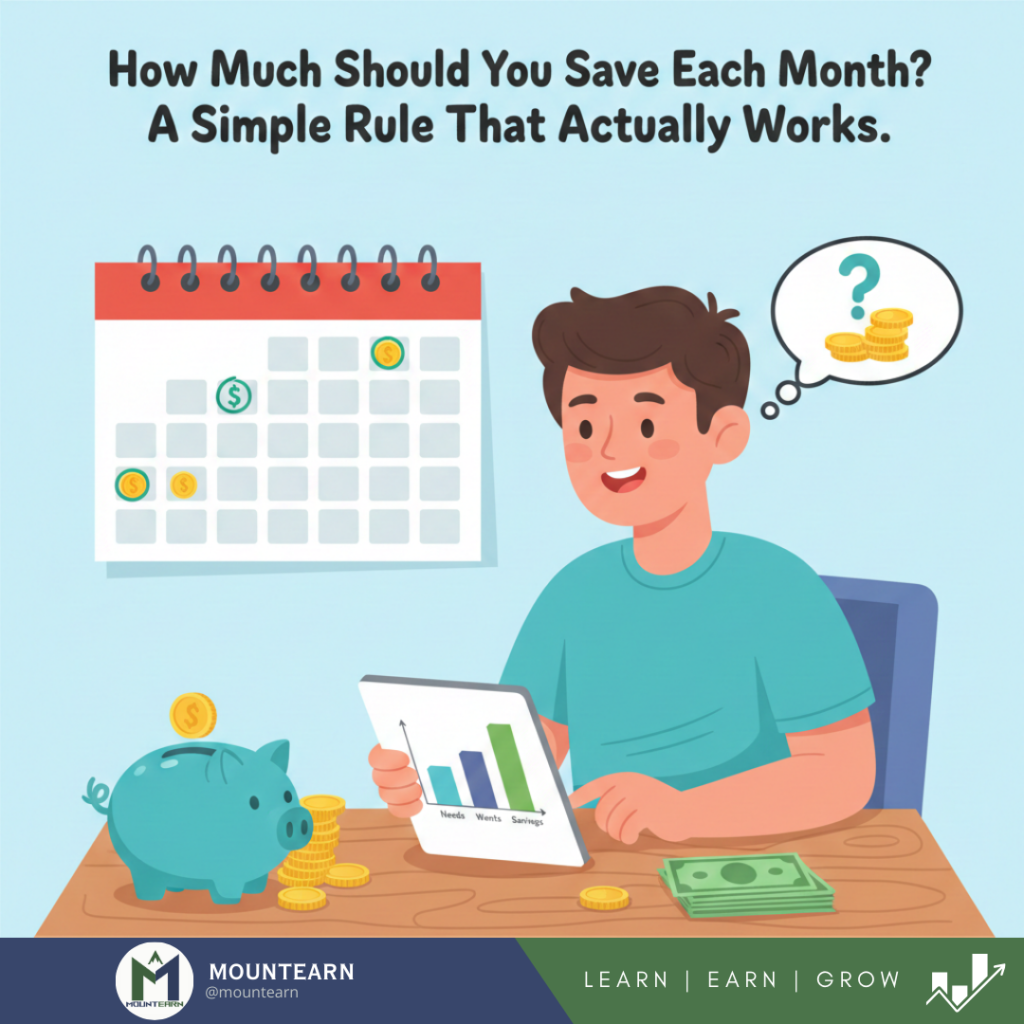
Why Saving Feels So Confusing (How Much Should you Save Each Month)
Most financial advice makes it sound like there is one “magic number” everyone should hit. You’ll hear people scream about saving 20%, 30%, or even 50% of your income. When you’re living paycheck to paycheck or just trying to keep up with rising rent, those numbers don’t feel inspiring—they feel impossible.
The confusion usually stems from three things:
- The “All or Nothing” Mentality: We think if we can’t save a huge chunk, there’s no point in saving at all.
- Information Overload: One “expert” says to invest, another says to build an emergency fund, and another says to pay off debt first. It’s paralyzing.
- The Comparison Trap: We see people on social media showing off their “savings hacks” and feel like we’re already too far behind to start.
Here is the truth: The best monthly savings rule isn’t the one that looks best on a calculator. It’s the one you can actually stick to without wanting to pull your hair out.
The 50/30/20 Rule: Your New Financial Best Friend
If you want a starting point that has stood the test of time, look no further than the 50/30/20 rule. It was popularized by Elizabeth Warren (a law professor before she was a senator), and it’s designed for “everyday people,” not just Wall Street types.
The beauty of this rule is that it doesn’t tell you what to buy; it tells you how to balance your life. Here is the breakdown of your take-home pay (the money that actually hits your bank account):
50% for Needs
These are the non-negotiables. Rent or mortgage, utilities, groceries, insurance, and minimum debt payments. If you stopped paying these, your life would get very difficult very quickly.
30% for Wants
This is the “fun” category. Dining out, Netflix subscriptions, hobbies, that extra-nice coffee, or a new pair of shoes. This category exists so you don’t feel like a robot. Living a life where you never spend on things you enjoy is a recipe for “savings burnout.”
20% for Savings and Debt Repayment
This is the answer to our big question. Under this rule, you aim to put 20% of your income toward your future. This includes building an emergency fund, putting money into a retirement account, or making extra payments on high-interest debt (like credit cards).
Why This Rule Actually Works in Real Life
You might be looking at that 20% and thinking, “That’s still a lot of money.” But here is why this specific framework is so effective for beginners:
1. It Focuses on Ratios, Not Dollars
Whether you make $2,000 a month or $10,000, the percentages stay the same. It scales with you. It acknowledges that as your income grows, your lifestyle might grow a bit, too—but your savings should grow right along with it.
2. It Gives You “Permission” to Spend
Most people fail at saving money because they try to cut out every single ounce of joy. They stop going to movies, they stop seeing friends, and they feel miserable. The 30% “Wants” category is a safety valve. It acknowledges that you are a human being who deserves a life today while planning for tomorrow.
3. It Prioritizes the “Future You”
By setting a target, you stop asking “how much should I save each month?” and start asking “how can I fit my life into these buckets?” It turns saving from an afterthought into a priority.
What If 20% Feels Impossible Right Now?
Let’s get real. If you’re currently saving 0%, jumping straight to 20% is like trying to run a marathon when you haven’t walked around the block in a year. You’re going to get sore, and you’re going to quit.
If your budget is tight, here is how to adjust the rule:
- The 1% Start: Can you save just 1% of your paycheck? For most people, that’s the cost of one takeout meal. Start there. Once you realize you don’t miss that 1%, move it to 2%.
- The “Needs” Audit: If your “Needs” (rent, car, etc.) are taking up 70% of your income, you physically cannot save 20% yet. That’s okay. Your goal is to slowly find ways to lower those needs or increase your income over time.
- The Seasonal Approach: Some months are harder than others (hello, December). It’s okay to save less during expensive months as long as you promise to pick it back up in the “cheaper” months.
Personal finance basics are about progress, not perfection. Saving $20 a month is infinitely better than saving $0 a month.
Common Saving Mistakes Beginners Make (And How to Avoid Them)
Even with a simple rule, it’s easy to trip up. Here are the most common traps people fall into when they start their saving money journey:
1. Saving “What’s Left Over”
If you wait until the end of the month to see what’s left in your account to save, the answer will almost always be zero. Money has a way of disappearing when it’s just sitting in a checking account.
- The Fix: “Pay yourself first.” Treat your savings like a bill that must be paid as soon as your paycheck hits.
2. Not Having an Emergency Fund First
Many people jump straight into “investing” because they want to see their money grow fast. But if your car breaks down and all your money is locked in an investment account, you’ll end up putting the repair on a credit card.
- The Fix: Build a “Starter Emergency Fund” of $1,000 (or one month of expenses) before doing anything else. It acts as a shield for your savings.
3. Being Too Restrictive
If you try to live on just rice and beans to hit a high savings goal, you’ll eventually “binge spend” out of frustration.
- The Fix: Keep that 30% “Wants” category healthy. It’s the secret sauce to long-term success.
Practical Tips to Save Consistently Without Stress
Ready to put the monthly savings rule into action? Here are a few ways to make it feel effortless:
- Automate Everything: This is the “cheat code” of personal finance. Set up an automatic transfer from your checking account to your savings account for the day after payday. If you don’t see the money, you won’t miss it.
- Use High-Yield Savings Accounts: Most regular banks pay you pennies in interest. A High-Yield Savings Account (HYSA) can pay significantly more just for letting your money sit there. It’s free money.
- The “24-Hour Rule”: Before buying something in your “Wants” category that costs more than $50, wait 24 hours. Usually, the impulse fades, and that money stays in your pocket.
- Track, Don’t Obsess: Use a simple app or a notebook to track where your money goes for one month. Don’t judge yourself; just observe. Knowledge is power.
Your Small Step for Today
Figuring out how much should you save each month isn’t a math problem—it’s a habit problem. You don’t need to be a financial genius to build a secure future; you just need to be consistent.
You don’t have to overhaul your entire life by tomorrow morning. You just need to start.
Here is your one actionable step for today: Open your banking app and look at your total income from last month. Multiply that number by 0.01 (that’s 1%). Does that number feel doable? If yes, set up an automatic transfer for that tiny amount to go into a savings account tomorrow.
You’ve just started. And honestly? Starting is the hardest part.
