

The Silent Money Leaks Draining Your Bank Account (And How to Stop Them)
It is a Tuesday evening, and you are looking at your bank account. You know you got paid last Friday. You haven’t bought a new car, you haven’t gone on a lavish vacation, and you certainly haven’t been throwing parties. Yet, the balance is hundreds of dollars lower than you expected.
You start scrolling through your transaction history, looking for the “big” mistake. But there isn’t one. There is no single $500 charge staring back at you. Instead, there is a long, numbing list of $9, $12, and $24 transactions.
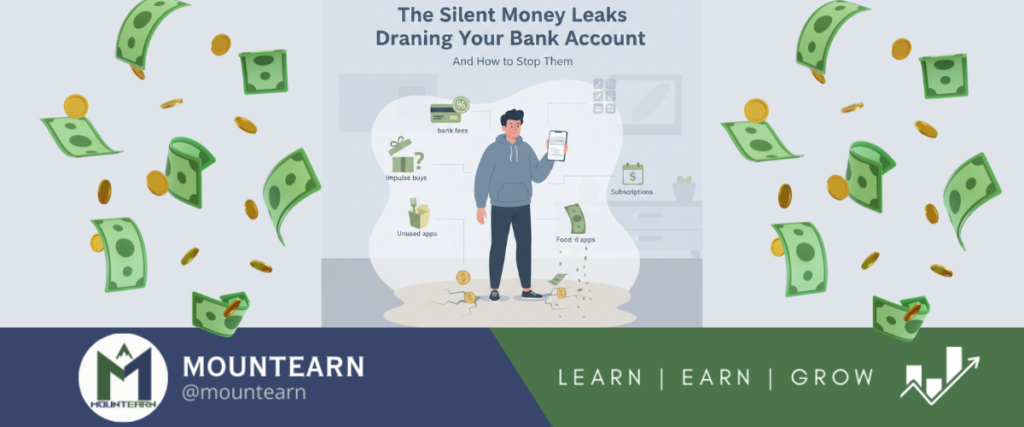
This is the reality of silent money leaks. They aren’t a flood; they are a slow drip behind the drywall of your life. You don’t notice them until the wood starts to rot. If you feel like you earn decent money but never have anything left to show for it, you aren’t careless. You’re likely just dealing with a dozen tiny holes in your bucket.
What Are Silent Money Leaks?
In plain language, silent money leaks are recurring or habitual expenses that have become invisible to you. They are the costs you’ve automated, the habits you’ve justified, and the “small” prices you’ve stopped questioning.
The danger isn’t the amount of a single leak; it’s the consistency. A $15 subscription you don’t use feels like nothing today. But over five years, that is $900 gone for literally zero value. When you have five or six of these leaks happening at once, you are losing thousands of dollars a year.
The Most Common Silent Money Leaks
To stop the drainage, we have to find the cracks. Here are the most common places your money is escaping.
1. The Forgotten Subscription
We’ve all done it. You signed up for a free trial to watch one documentary or get free shipping on one order. Then you forgot. Or, you still use the service, but you’ve upgraded to a “Premium” tier you don’t actually need.
- The Fix: Go to your app store settings and your bank statement. If you haven’t used it in thirty days, cancel it. You can always sign up again later if you truly miss it.
2. Convenience as a Service
Food delivery apps are the ultimate silent money leak. It’s not just the price of the food; it’s the delivery fee, the service fee, the small order fee, and the tip. A $15 burrito becomes a $32 expense.
- The Fix: Use the “Delete and Redownload” rule. Delete the delivery apps. If you really want something, you have to drive to get it. If you aren’t willing to drive, you aren’t actually that hungry.
3. Lifestyle Inflation
When you get a raise, your spending tends to rise to meet it. You start buying the “better” brand of coffee or the “nicer” paper towels. Individually, these feel like rewards for hard work. Collectively, they ensure you stay at the same level of financial stress despite making more money.
- The Fix: The next time you get a raise, automate half of that increase directly into savings before you even see it in your checking account.
4. The “Small” Daily Purchase
The $4 energy drink or the $6 coffee isn’t the problem. The problem is the habit of the purchase. When a purchase becomes automatic, you stop receiving joy from it. It just becomes something you do to get through the morning.
- The Fix: Don’t ban the treat, but make it an intentional choice. Try “Cash Only” for your daily snacks. When you physically hand over five dollars every day, you start to notice the cost.
5. Bank Fees and Interest
Paying a bank to hold your money or paying 20% interest on a credit card balance is essentially throwing money into a fire. Overdraft fees and “monthly maintenance fees” are often avoidable if you just ask or switch banks.
- The Fix: Call your bank. Ask them to waive the fee or move you to a no-fee account. For credit cards, even a 2% reduction in interest can save you hundreds over time.
6. Emotional and Stress Spending
We often use money to solve a feeling. If you had a bad day at work, you might “treat yourself” to a new gadget or an expensive meal. This is a temporary fix for a permanent problem.
- The Fix: Implement a 72-hour rule. If you want to buy something non-essential, put it in the cart but don’t checkout for three days. Usually, the “need” fades once the stress of the day passes.
7. Not Tracking the Flow
If you don’t know where the money is going, you can’t stop it from leaving. Most people avoid looking at their bank accounts because it causes anxiety. But that avoidance is what allows bad spending habits to grow.
- The Fix: You don’t need a complex spreadsheet. Just look at your transactions once a week. Awareness alone usually reduces spending by 10%.
Why Cutting Big Expenses Isn’t Always the Answer
When people want to start saving money, they immediately think about the big stuff. They think they need to move to a cheaper apartment or sell their car. While those things help, they are high-effort and high-stress.
Fixing personal finance mistakes is often more effective when you focus on the “middle” of your budget. If you cut your rent by $200 but keep your silent money leaks, that $200 will just disappear into more delivery fees and unused apps. Fixing the leaks builds the discipline you need to manage the big money later.
Your Weekend Money Reset Plan
If you’re ready to stop the leaks, do these four things this weekend. It will take about an hour.
- Print your last 30 days of transactions. Yes, print them or look at them on a large screen. Seeing the list in its entirety is eye-opening.
- Highlight the “Invisible” costs. Circle every subscription, every delivery fee, and every impulse buy. Don’t judge yourself; just identify them.
- The “Power of Three” Cancellation. Find at least three things you can cancel or stop immediately. Maybe it’s a streaming service, a gym you don’t go to, and a recurring donation to a cause you no longer follow.
- Set an “Unsubscribe” Timer. Spend 15 minutes opening marketing emails in your inbox and clicking “Unsubscribe.” If you don’t see the sale, you won’t feel the urge to spend.
Final Thoughts
Managing your money isn’t about being perfect, and it’s certainly not about living a life where you never buy anything fun. It is about making sure that your hard-earned cash is going toward things that actually matter to you.
When you plug these silent money leaks, you aren’t just saving money; you’re taking back control. You’re deciding that your future security is more important than a “free trial” you forgot to cancel.
Be patient with yourself. You didn’t develop these habits overnight, and you won’t fix them all by Monday. But once you start looking for the leaks, they become much harder for your bank account to ignore.
If you looked at your bank statement right now, what is one recurring charge you know you could live without?
More Posts
- 3 Easy Ways to Make Extra Money 2026: AI Jobs, UGC, and More
- Stop Chasing More Income Until You Fix This First
- A Simple 10-Minute Weekly Money Routine That Changed Everything
If you like photo editing; Here’s Presets
