The Invisible Money Leaks No One Warns You About

You just got paid. You look at your bank balance on Friday afternoon, and for a fleeting moment, you feel like royalty. You have a plan for every dollar. But then, Monday rolls around, and you find yourself staring at your banking app in confusion. Where did that $150 go?

You didn’t buy a new TV. You didn’t go on a shopping spree. You just… lived. This is the frustrating reality for many people starting their financial journey. You try to be careful, yet your account balance seems to evaporate into thin air. These are invisible money leaks, and they are the silent killers of even the best financial intentions.

If you feel like you are working hard but have nothing to show for it, you aren’t failing at life. You are likely just dealing with small, recurring charges that are too small to notice but too frequent to ignore.

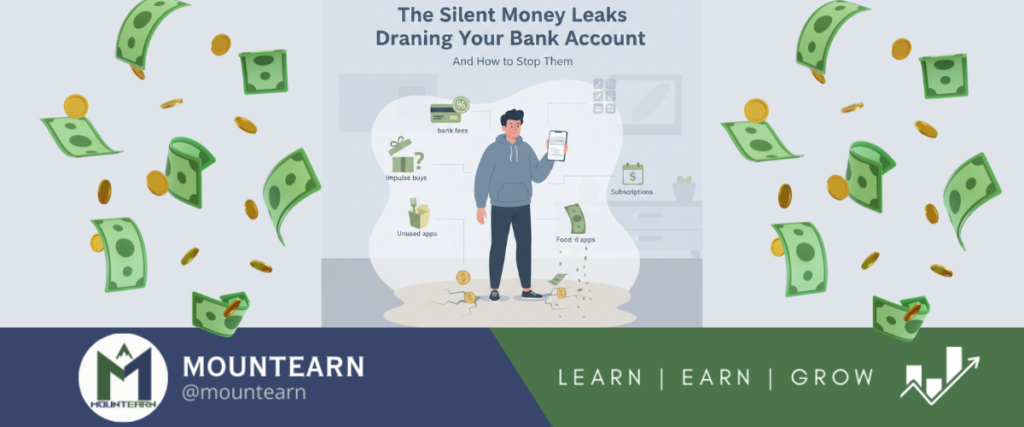
Cartoon illustration showing invisible money leaks from subscriptions, coffee, bank fees, and credit card interest draining a person’s finances

What Are Invisible Money Leaks?

Think of your bank account like a large water tank. Most people focus on the giant faucets—rent, car payments, and groceries. You watch those closely because they are obvious. However, invisible money leaks are like tiny pinpricks in the bottom of that tank.

One tiny hole doesn’t seem like a big deal. But if you have twenty of them dripping 24 hours a day, the tank will be empty by morning. In financial terms, these are the small, automatic, or habitual costs that you’ve stopped “seeing” because they’ve become part of your daily background noise.


Common Invisible Money Leaks That Drain Your Income

Most beginners think they have a “spending problem,” but usually, they just have a “leak problem.” Here are the most common places your hard-earned cash is escaping.

Subscription Services

We live in the era of the $10 subscription. It’s just the price of a sandwich, right? But between streaming apps, gym memberships you haven’t used since January, and that “pro” version of a photo editor you used once, you could be losing $100 a month. These monthly subscriptions are designed to be forgotten. Companies count on you being too busy to hit the cancel button.

Bank Fees and Maintenance Charges

It is your money—you shouldn’t have to pay to keep it in the bank. Yet, many people overlook recurring charges like $12 monthly maintenance fees or $2.50 out-of-network ATM fees. If you pay an ATM fee twice a week, you’re losing over $250 a year just for the “privilege” of accessing your own cash.

Impulse Micro-Purchases

This is the “Target Effect” or the “Amazon One-Click” trap. It’s the $5 pack of gum, the $3 app upgrade, or the $7 snack at the gas station. These don’t feel like “shopping,” so they don’t trigger the guilt that a $200 jacket would. Because they don’t hurt, you keep doing them, often several times a day.

Convenience Spending

We are a tired generation. Sometimes, paying $15 for delivery because you don’t want to drive five minutes to get your food feels worth it. But when you add up the delivery fees, service fees, and tips, you are often paying a 50% markup on your meal. This is one of those hidden expenses that masquerades as “self-care” but actually causes more financial stress in the long run.

Interest on Small Debts

If you carry a balance on your credit card, even a small one, you are leaking money through interest. Paying the minimum might keep the creditors away, but it ensures that your $40 pizza delivery eventually costs you $60.


Why These Small Leaks Add Up Fast

There is a psychological reason why we ignore these costs. Our brains are wired to notice “shocks” but ignore “patterns.” If someone stole $500 from your wallet, you’d call the police. But if your bank account “loses” $2 a day over a year, you barely blink.

Meet Sarah. Sarah is a teacher who felt she was underpaid because she could never save money. When we looked at her “leaks,” we found a $15 streaming service she forgot she had, a $40 monthly yoga membership she stopped attending, and a habit of buying a $6 latte every work morning.

None of these things made Sarah “poor.” However, combined, they were costing her $175 a month. That is $2,100 a year. Once Sarah saw that number, she realized she didn’t have an income problem; she had a “drip” problem.


How to Find Your Invisible Money Leaks

You don’t need a complicated spreadsheet to fix this. You just need an hour of honesty and a highlighter.

  1. Print Your Last 30 Days of Statements: Don’t just look at them on your phone. Print them out or open them on a large screen.
  2. The “Wait, What’s That?” Test: Look for any charge you don’t immediately recognize. If you have to think about what a $14.99 charge from “ABC-Media-Tech” is, it’s a leak.
  3. Identify the “Convenience Tax”: Circle every time you paid for delivery, a convenience store snack, or an ATM fee.
  4. Audit Your Subscriptions: Look for the words “Recurring” or “Monthly.” Be ruthless. If you haven’t used it in the last 30 days, you don’t need it today.

How to Fix Invisible Money Leaks Without Extreme Budgeting

You don’t have to live on rice and beans to secure your future. You just have to be intentional. These are the most common budgeting mistakes, but they are also the easiest to fix.

Use the 24-Hour Rule

For any “micro-purchase” over $5, wait 24 hours. Put it in your digital cart and walk away. If you still want it tomorrow, get it. Most of the time, the impulse fades, and the leak is plugged.

Automate Your Savings, Not Your Spending

Most of us have our Netflix and Spotify on autopilot. Try putting your savings on autopilot instead. Set up a transfer of just $25 a week to a separate savings account. You’ll stop “seeing” that money, and it will grow instead of leaking out.

Switch to a No-Fee Bank

If your bank is charging you just to hold your money, leave. There are countless online banks and credit unions that offer zero-fee checking accounts. It takes 20 minutes to switch and saves you money forever.

Audit Your Digital Footprint

Go into the “Subscriptions” section of your smartphone settings. You will likely find at least one app charging you for a “premium” feature you forgot you signed up for. Cancel it immediately. You can always sign up again later if you truly miss it.


Your New Financial Habits Start Today

Finding invisible money leaks isn’t about depriving yourself of joy. It’s about making sure your money goes toward things that actually matter to you. Why give $15 a month to a streaming service you never watch when that money could go toward your first home or a vacation you’ll actually remember?

You work too hard to let your income disappear into a black hole of convenience fees and forgotten memberships. By taking one hour today to scan your statements, you are taking back control. You are deciding that you, not a subscription algorithm, get to choose where your wealth goes.

Start small. Cancel one thing today. Stop one impulse purchase tomorrow. You will be amazed at how quickly those tiny drops turn into a flood of financial freedom. You have the power to plug the leaks; all you have to do is start looking for them.


More Posts

  1. 50 Simple Ways to Save Money Without Feeling Poor (Easy Tips That Work)
  2. How the Money Habit That Ruins Your Finances Slowly Drains Your Money
  3. Faceless Side Hustles: Earn Money Without Talking or Selling

If you like photo editing. Here some presets
50 Simple Ways to Save Money Without Feeling Poor (Easy Tips That Work)

Let’s be real: most “frugal living” advice sounds absolutely miserable. Usually, it’s some variation of “stop buying coffee” or “live in a dark room to save on electricity.” That’s not a lifestyle; that’s a punishment.

The truth is, you don’t have to live on beans and toast to build a solid savings account. You just need to be a little more intentional with how your cash flows out of your pocket. By making small, barely noticeable tweaks to your daily routine, you can keep more of your paycheck without sacrificing your happiness.

If you’re looking for ways to save money without feeling poor, you’ve come to the right place. Here are 50 simple, painless ways to cut costs and still enjoy your life.

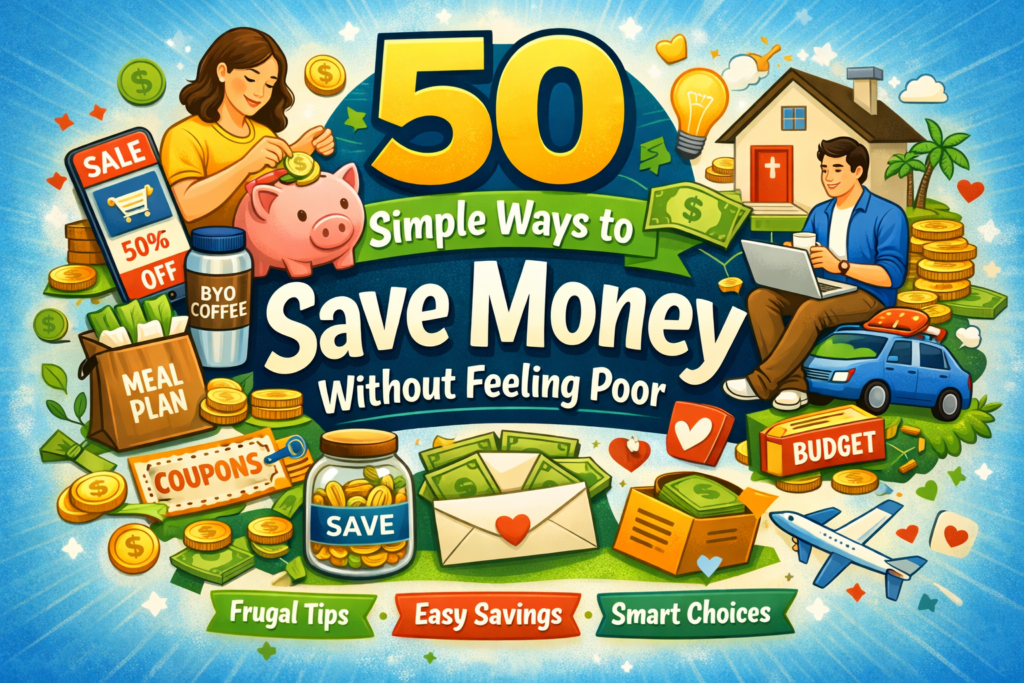
Illustration showing simple ways to save money without feeling poor, including a piggy bank, budgeting tips, coupons, and smart spending icons.

Everyday Spending Habits

Improving your daily habits is the fastest way to see results. These small shifts add up to massive gains over a year.

  1. The 24-Hour Rule: Before buying anything non-essential, wait 24 hours. Usually, the “must-have” feeling fades.
  2. Unsubscribe from Retail Emails: If you don’t see the sale, you won’t spend the money.
  3. Use Cash for Fun: When you go out, take a set amount of cash. When it’s gone, the night is over.
  4. Track Every Penny: Use an app or a simple notebook. Just seeing where the money goes stops mindless spending.
  5. Calculate Cost in Hours: If a pair of shoes costs $100 and you make $25/hour, ask yourself: “Is this worth 4 hours of my life?”
  6. Avoid “Target Trips”: Don’t go to the store just to “look around.” You’ll leave $80 poorer with a candle you didn’t need.
  7. Automate Your Savings: Set up a transfer to your savings account the day you get paid. If you don’t see it, you won’t miss it.
  8. The “Round-Up” Method: Use a banking app that rounds up your purchases to the nearest dollar and saves the change.

Grocery & Food Savings

Food is usually the biggest “leak” in a budget. Here are simple ways to save money without feeling poor while still eating like a king.

  1. Meal Prep (Loosely): You don’t need fancy containers. Just plan three dinners a week so you don’t order pizza when you’re tired.
  2. Buy Store Brands: Most generic pasta, salt, and canned beans are identical to name brands but 30% cheaper.
  3. Never Shop Hungry: Everything looks delicious when your stomach is growling.
  4. Frozen Veggies are Gold: They don’t spoil, they’re pre-chopped, and they’re often more nutritious than “fresh” stuff that sat on a truck for a week.
  5. Regrow Your Scallions: Put the white ends in a jar of water. Free onions for life!
  6. Meatless Mondays: Meat is expensive. Swapping one night for a hearty lentil soup or bean tacos saves a ton.
  7. Check the Unit Price: Don’t look at the total price; look at the price per ounce on the shelf tag to find the real deal.
  8. Brew Your Own Coffee: You don’t have to quit caffeine. Just invest in a decent travel mug and a bag of good beans.
  9. Eat Your Leftovers: This is the easiest way to get a “free” lunch.

Smart Ways to Save Money Without Feeling Poor on Bills

Fixed expenses are the “silent killers” of wealth. Once you lower these, the savings happen on autopilot.

  1. The Annual Subscription Audit: Go through your bank statement. That $7 app you haven’t used in six months? Cancel it.
  2. Call Your Internet Provider: Tell them you’re thinking of switching. Often, they’ll “find” a promotion to keep you.
  3. Switch to Mint Mobile or Visible: Why pay $90 for a phone plan when you can pay $15 for the same towers?
  4. Adjust Your Thermostat: Turning it down just 2 degrees in winter can shave 5-10% off your bill.
  5. Wash Clothes in Cold Water: It’s better for your clothes and saves on water heating costs.
  6. Use a Library Card: You can get books, movies, and even museum passes for free. It’s the ultimate life hack.
  7. Cancel Cable: Between YouTube and one or two streaming services, you really don’t need a $150 cable bill.
  8. Check Your Insurance Rates: Shop around for car insurance every two years. Loyalty rarely pays in the insurance world.

Smart Shopping Tricks

You can still buy things! You just need to be strategic about it.

  1. Buy Out of Season: Buy your winter coat in July and your swimsuit in September.
  2. Browser Extensions are Your Friend: Use tools like Honey or Rakuten to automatically find coupons and cash back.
  3. Thrift First: For furniture or home decor, check Facebook Marketplace or local thrift stores before buying new.
  4. The “Used” Amazon Option: Check the “Used – Like New” section on Amazon for returned items at a deep discount.
  5. Avoid the Convenience Tax: Don’t buy pre-cut fruit or individual snack packs. Buy the big bag and spend 5 minutes portioning it out.
  6. Generic Meds: Store-brand Ibuprofen is the exact same molecule as Advil. Save the $4.
  7. Rent, Don’t Buy: Need a power drill for one project? Borrow it from a neighbor or rent it from a hardware store.

Lifestyle Changes That Don’t Feel Like Sacrifice

Living well is about experiences, not just things. Here are ways to save money without feeling poor while still having fun.

  1. The “Home-Gating” Party: Instead of a $100 night at the bar, have friends over for drinks and board games.
  2. Walk or Bike More: If it’s under a mile, leave the car. It’s free exercise and saves gas.
  3. Master the “Free Weekend”: Look for local parks, free community concerts, or hiking trails.
  4. Learn Basic Repairs: YouTube can teach you how to fix a leaky faucet or patch a hole in your jeans.
  5. Host a Clothing Swap: Refresh your wardrobe for free by trading clothes with friends.
  6. Drink Water at Restaurants: A $3.50 soda or an $11 cocktail adds up fast. Stick to water and enjoy the food.
  7. Quality Over Quantity: Buy one $60 pair of shoes that lasts three years instead of three $25 pairs that fall apart in months.
  8. Tidy Your House: When your home is clean, you “discover” things you forgot you owned, which prevents buying duplicates.
  9. Cancel the Gym (If You Don’t Use It): There are amazing free workouts on YouTube that require zero equipment.

Long-Term Money Habits

These are the big-picture moves that build real wealth over time.

  1. Increase Your Income: Sometimes the best way to save is to make more. Look for a side hustle or ask for a raise.
  2. Avoid Lifestyle Creep: When you get a raise, don’t upgrade your car. Put that extra money straight into savings.
  3. Pay Off High-Interest Debt: Credit card interest is a fire that burns your wealth. Put out the fire first.
  4. Max Out Employer Matching: If your job offers a 401k match, that is 100% free money. Don’t leave it on the table.
  5. Use a High-Yield Savings Account (HYSA): Stop keeping your emergency fund in a big bank earning 0.01%. Move it to an HYSA and let it grow.
  6. Set Specific Goals: “Saving money” is boring. “Saving $2,000 for a trip to Italy” is motivating.
  7. Review Your Progress Monthly: Celebrate when you hit a milestone. It keeps the momentum going.
  8. Stay Away from Lifestyle Comparison: Don’t try to keep up with influencers. Their “wealth” is often just debt in pretty packaging.
  9. Forgive Yourself: If you have a bad spending day, don’t give up. Just start fresh tomorrow.

Frequently Asked Questions

How can I save money fast?

The fastest way to save is to cut a major fixed expense, like moving to a cheaper apartment or selling a car with a high payment. For daily savings, try a “No-Spend Weekend” where you only use what you already have in the house.

What is the easiest way to start saving?

Start by automating a small amount—even just $10 or $20—to go into a separate savings account every payday. You’ll adjust to the new “paycheck” amount almost instantly.

How do I save money without feeling like I’m missing out?

Focus on “Value Spending.” Cut the things you don’t care about (like premium cable or fancy car washes) so you have plenty of money for the things you do love (like travel or high-quality food).

Is it worth saving small amounts?

Absolutely. Saving $5 a day might not seem like much, but that’s over $1,800 a year. Small habits build the “savings muscle” that leads to big wealth.


Final Thoughts

Saving money isn’t about deprivation; it’s about freedom. Every dollar you don’t spend on something meaningless is a dollar that buys you future security and better choices.

Start with just three tips from this list this week. Once those feel natural, add three more. Before you know it, you’ll be building a financial cushion without ever feeling like you’re “on a budget.”

Which of these tips are you going to try first? Drop a comment below and let’s hold each other accountable!


More Posts

  1. How the Money Habit That Ruins Your Finances Slowly Drains Your Money
  2. Faceless Side Hustles: Earn Money Without Talking or Selling
  3. 10 Smart Money Habits That Can Improve Your Financial Life

If you’re like photography: check out these

How the Money Habit That Ruins Your Finances Slowly Drains Your Money

I used to think my bank account had a leak.

A few years ago, I got a decent raise. I remember sitting at my desk, looking at the new numbers on my screen, and feeling a huge sense of relief. I thought, “This is it. I’m finally going to have a cushion.”

But three months later, I was still staring at my phone on a Tuesday night, wondering why I only had $42 left in my checking account. Nothing major had happened. My car hadn’t broken down. I hadn’t gone on a wild shopping spree.

I was earning more, yet I felt more broke than ever.

That was the moment I realized I was falling victim to the one money habit that ruins your finances without you even noticing. It wasn’t a one-time disaster. It was a slow, quiet bleed that happened every single day.

money habit that ruins your finances through daily spending mistakes

What Is the Money Habit That Ruins Your Finances?

If you asked me back then what my biggest financial problem was, I would have said I didn’t earn enough. Most of us say that. But the truth is much simpler and a lot harder to admit.

The habit is mindless convenience spending.

It’s the habit of saying “it’s just ten dollars” or “it’s only a few bucks a month” every time life gets a little bit inconvenient or boring. It’s the $6 latte because you’re tired. It’s the $15 delivery fee because you don’t feel like driving five minutes. It’s the $12 subscription for a streaming service you haven’t opened since 2022.

These aren’t huge life decisions. They are tiny, reflexive choices. We make them when we are stressed, busy, or just not paying attention. We think we are buying time or comfort, but we are actually buying a future full of financial stress.


Why This Money Habit That Ruins Your Finances Is So Common

We live in a world designed to separate us from our cash as quickly as possible. Everything is a “one-click” purchase. Our credit card info is saved in every app. We don’t even have to reach for our wallets anymore; we just tap our phones.

This creates a mental shortcut. We stop seeing money as hours of our lives traded for a paycheck. Instead, we see it as a digital number that never seems to stay where it should.

There is also a lot of social pressure. We see our friends going out, ordering the extra appetizer, or upgrading their tech. We want to keep up. We don’t want to be the “boring” person who says no.

So, we say yes. We say yes to the small things over and over again until those small things become a mountain of bad money habits that we can’t climb over.


How the Money Habit That Ruins Your Finances Slowly Drains Your Money

Think about a leaky faucet. One drop doesn’t matter. But if you leave it for a month, you’ll find a flooded bathroom and a massive water bill.

Let’s look at the “money leaks” in a typical week:

  • Three food delivery orders: $45 in fees and tips.
  • Two “I forgot to pack lunch” meals: $30.
  • Four streaming subscriptions you rarely use: $60 per month.
  • The “it was on sale” item you didn’t need: $25.

Suddenly, you’ve spent $160 without even trying. Over a year, that is nearly $2,000. That’s a vacation. That’s an emergency fund. That’s the “cushion” you thought you’d have after your last raise.

The psychological impact is even worse than the math. When you constantly spend mindlessly, you lose the sense of being in control. You start to feel like money is something that happens to you, rather than something you manage.


Signs You Have This Money Habit

It can be hard to spot this habit because it hides in plain sight. However, there are a few red flags that suggest you might be suffering from these personal finance mistakes:

  • The “Where Did It Go?” Feeling: You look at your balance at the end of the month and genuinely can’t remember where half of it went.
  • Income Growth, No Savings: You’ve had a raise or a bonus in the last year, but your savings account hasn’t moved an inch.
  • Constant Low-Level Anxiety: You’re not “broke” in the traditional sense, but you always feel like you’re one unexpected bill away from a crisis.
  • The Subscription Surprise: You see a charge on your bank statement and have to spend five minutes Googling the company name to remember what it is.

How to Fix the Money Habit That Ruins Your Finances

The good news is that you don’t need to live like a monk to fix this. You just need to stop being a passenger in your own financial life.

1. The 24-Hour Rule

Before you buy anything that isn’t a necessity, wait 24 hours. Most of the “convenience” or “impulse” urges fade by the next morning. If you still want it then, at least it’s a choice, not a reflex.

2. Audit Your Digital Life

Go through your bank statement from last month. Highlight every recurring subscription. If you haven’t used it in the last 30 days, cancel it. You can always sign up again later if you truly miss it.

3. The Weekly Check-In

Don’t wait until the end of the month to look at your spending. Spend ten minutes every Sunday morning looking at your transactions. It’s not about judging yourself. It’s about building awareness.

4. Use Cash for “Fun”

If you struggle with budgeting mistakes when you’re out with friends, try using cash. When the bills in your pocket are gone, the spending stops. It’s a physical boundary that a credit card can’t provide.


Why Fixing This Habit Matters More Than Earning More

I used to believe that a bigger salary was the cure for all my problems. I was wrong. If you have a hole in your bucket, pouring more water in won’t fill it up. You have to plug the hole first.

Fixing the money habit that ruins your finances gives you something that a high salary alone never can: peace of mind.

When you stop the mindless leaks, you realize you actually have enough. You realize that you don’t need to work twice as hard to feel secure. You just need to be twice as intentional.

There is a specific kind of freedom that comes from knowing exactly where your money is going. It stops being a source of fear and starts being a tool for the life you actually want to live.


Fixing your finances isn’t about being perfect. It’s about being honest.

We all have that one thing we spend too much on without thinking. For me, it was takeout coffee and “easy” dinners. For you, it might be something else.

Don’t beat yourself up about it. Just notice it. Once you see the habit, it loses its power over you.

Take a look at your bank app today. Find one “money leak” you can stop right now. It might only be $10, but it’s the first step toward taking your power back.


More Posts

  1. Faceless Side Hustles: Earn Money Without Talking or Selling
  2. 10 Smart Money Habits That Can Improve Your Financial Life
  3. I Tracked Every Penny I Spent for 30 Days – Here’s What Surprised Me

If you interested in photography: Check out these

Faceless Side Hustles: Earn Money Without Talking or Selling

We have all seen the gurus on social media. They are loud, they are always on camera, and they make it seem like the only way to earn extra money is by becoming a public personality or a high-pressure salesperson. For many of us, that sounds like a nightmare. If the idea of jumping on a Zoom call or filming a “day in the life” video makes you want to close your laptop forever, you are not alone.

Faceless side hustles are becoming the go-to solution for people who value their privacy as much as their bank balance. These are roles where your work speaks for itself, allowing you to earn an income from behind a screen without ever having to show your face or hop on a sales call. Whether you are an introvert or just someone who wants to keep their professional and private lives separate, there is a quiet way to build a second income stream.

faceless side hustles ideas

Why Faceless Side Hustles Are Perfect for Introverts

The modern economy often feels like it was built for extroverts. However, faceless side hustles flip that script by prioritizing output over personality. The most obvious benefit is the lack of social exhaustion. You do not have to “perform” or worry about your appearance. You can work in your pajamas from a coffee shop or your couch, and no one is the wiser.

Privacy is another massive factor. Maybe you have a day job and do not want your employer or colleagues knowing about your extra ventures. Or perhaps you just do not want your image floating around the internet. By focusing on tasks like data management, writing, or digital creation, you maintain total control over your identity. It lowers the barrier to entry because the anxiety of being “seen” is completely removed from the equation.


Best Faceless Side Hustles for Beginners

Finding the right fit depends on your interests, but these options are great starting points for anyone who wants to stay behind the scenes.

Data Entry and Spreadsheet Management This is the classic quiet job. Many small businesses have raw data that needs to be organized into spreadsheets. It requires focus and basic knowledge of Excel or Google Sheets.

  • How it works: You receive files or documents and input the data into a specific format.
  • Skill level: Beginner.
  • Earning potential: Generally $15 to $25 per hour depending on speed and accuracy.

Transcription Services If you are a fast typer and have a good ear, transcription is a solid choice. You listen to audio files and type out what is being said.

  • How it works: You sign up for platforms like Rev or TranscribeMe and claim available audio “jobs.”
  • Skill level: Beginner to Intermediate.
  • Earning potential: Usually $10 to $20 per active audio hour; specialized legal or medical transcription pays more.

Pinterest Management Many bloggers and e-commerce stores need someone to create pins and schedule them using tools like Tailwind. You never have to talk to their customers; you just manage the visual feed.

  • How it works: You design simple graphics on Canva and schedule them to go live.
  • Skill level: Intermediate (requires a bit of design sense).
  • Earning potential: $300 to $500 per month per client.

Stock Photography and Videography You do not need to be in the photos to sell them. If you have a decent camera or even a high-end smartphone, you can take photos of nature, textures, or everyday objects.

  • How it works: Upload your files to sites like Shutterstock or Adobe Stock. You earn a royalty every time someone downloads your work.
  • Skill level: Intermediate.
  • Earning potential: A few cents to a few dollars per download; it scales as your portfolio grows.

User Testing Companies want to know if their websites are easy to use. You record your screen while navigating a site and speak your thoughts aloud. While you use your voice, your face is never on camera.

  • How it works: Follow a set of tasks on a website and provide honest feedback.
  • Skill level: Beginner.
  • Earning potential: Typically $10 for a 20-minute test.

Ghostwriting and Content Writing If you enjoy writing, you can write articles, blog posts, or newsletters for others. The “ghost” part means you do not get a byline, which is perfect for staying anonymous.

  • How it works: Freelance on platforms or reach out to blogs to write content under their brand name.
  • Skill level: Intermediate.
  • Earning potential: $0.05 to $0.15 per word for beginners.

Tools and Skills Needed for Faceless Side Hustles

You do not need a fancy office or expensive equipment to get started. For most of these roles, a reliable laptop and a stable internet connection are 90% of the battle. If you are leaning toward creative work, free tools like Canva for design or CapCut for simple video editing are more than enough.

The most important “soft skill” is actually discipline. Because you are working solo and often without a manager hovering over you, being able to hit deadlines on your own is vital. You also need basic digital literacy—knowing how to navigate cloud storage like Google Drive or Dropbox and understanding how to communicate clearly via email or chat apps.


Common Mistakes to Avoid When Starting Faceless Side Hustles

One of the biggest traps beginners fall into is “analysis paralysis.” They spend weeks researching the perfect hustle instead of just trying one. It is better to try something for two weeks and realize you hate it than to spend two months wondering if it works.

Another mistake is falling for “get rich quick” schemes. If a side hustle promises you thousands of dollars in your first week for almost no work, it is likely a scam. Real faceless work still requires time and effort. Lastly, do not ignore the “boring” stuff like tracking your income for taxes. Even though it is a side gig, treating it like a professional business from day one will save you a lot of headaches later.


Can Faceless Side Hustles Become Passive Income?

It is important to be realistic here. Most side hustles start as active income, meaning you get paid for the hours you put in. If you stop typing or stop testing websites, the money stops coming in. However, some faceless paths can transition into semi-passive income over time.

For example, stock photography or creating digital templates to sell on Etsy requires a lot of front-end work. Once those assets are uploaded, they can continue to sell while you sleep. It is rarely “set it and forget it,” as you usually need to update your portfolio or respond to occasional customer messages, but the link between your time and your money becomes much looser.


How to Choose the Right Faceless Side Hustle for You

Start by looking at your current routine. How much time can you actually give to this? If you only have thirty minutes a day, user testing or data entry might be best. If you have entire Saturday afternoons free, you might want to dive into writing or Pinterest management.

Pick one thing that aligns with a skill you already have. If you are organized, go with data entry. If you have an eye for color, try digital design. The goal is to reduce the friction of starting. Do not worry about building a perfect “brand” or a fancy website right away. Just find your first client or complete your first task to prove to yourself that earning money online is actually possible.


The beauty of the digital age is that there is room for everyone, not just the loudest voices in the room. You can build a very comfortable financial cushion without ever stepping into the spotlight or picking up a phone to cold-call a stranger.

Finding the right faceless side hustles takes a bit of experimentation and patience. Do not get discouraged if the first thing you try does not make you a millionaire overnight. The goal is steady, sustainable growth that fits your personality and your lifestyle. By focusing on providing value through your work rather than your image, you can enjoy both financial freedom and the peace of mind that comes with staying anonymous.


More Posts

  1. 10 Smart Money Habits That Can Improve Your Financial Life
  2. I Tracked Every Penny I Spent for 30 Days – Here’s What Surprised Me
  3. Zero to $100 in a Week: Beginner-Friendly Side Hustle Challenges

If you’re are photographer: you will need this presets

10 Smart Money Habits That Can Improve Your Financial Life

Have you ever looked at your bank account a week before payday and wondered where all your money went? You aren’t alone. Most of us have been there, staring at a screen and trying to remember if that one dinner out really cost that much.

The truth is, building wealth isn’t usually about winning the lottery or landing a high-paying executive job overnight. It is about what you do with your money every single day. By adopting smart money habits, you can stop living paycheck to paycheck and start building a life where you control your finances, rather than your finances controlling you.

In this guide, we will break down ten simple, practical habits that will help you improve your financial life and give you the peace of mind you deserve.

10 Smart Money Habits That Can Improve Your Financial Life | Personal Finance Tips

Why Your Habits Matter More Than Your Income

Most people think they have a “money problem” when they actually have a “habit problem.” You could earn a million dollars a year, but if you spend two million, you are still broke.

Good money management habits act like a GPS for your cash. They ensure that your hard-earned money is going toward things that actually matter to you—like a home, travel, or a stress-free retirement—instead of disappearing into small, mindless purchases.


1. Track Your Spending Without Judgement

You cannot fix what you do not see. The first of the many smart money habits you should adopt is tracking every dollar that leaves your pocket.

Many people avoid this because they feel guilty about their spending. However, tracking isn’t about shaming yourself; it’s about gathering data. Whether you use a simple notebook, a spreadsheet, or an app, knowing that you spent $100 on coffee last month allows you to decide if that’s a choice you want to keep making.

Action Tip: For the next 30 days, write down every single purchase, no matter how small.

2. Give Every Dollar a Job (Budgeting)

Budgeting has a bad reputation for being restrictive. In reality, a budget is just a plan. It is you telling your money where to go instead of wondering where it went.

Think of it like a sports team. You wouldn’t send players onto the field without a position. Your money is the same. Some dollars are for rent, some are for groceries, and some are for fun. When you give every dollar a job, you eliminate the “can I afford this?” anxiety.

3. Pay Yourself First

Most people pay their rent, their phone bill, and their Netflix subscription, and then they save whatever is left over. The problem? Usually, nothing is left over.

To truly improve your financial life, you must flip the script. Treat your savings like a mandatory bill. As soon as you get paid, move a set amount—even if it is just $20—into your savings account before you pay anyone else.

Real-Life Example: If you wait until the end of the month to save, you might buy a new pair of shoes you don’t need. If the money is already in savings, you’ll realize those shoes aren’t in the budget.

4. Build a “Small” Emergency Fund Fast

Life is unpredictable. Tires pop, sinks leak, and phones break. Without an emergency fund, these minor inconveniences become high-interest credit card debt.

Start by aiming for a $1,000 “starter” emergency fund. This isn’t your total life savings; it’s just a buffer to keep you from backsliding when life happens. Having this cash tucked away changes an emergency into a mere inconvenience.

5. Master the 48-Hour Rule for Big Purchases

We live in a world designed to make us spend. “Flash sales” and “one-click buys” are meant to trigger our emotions. One of the most effective money management habits is to enforce a waiting period.

If you see something you want that isn’t a necessity, wait 48 hours before buying it. Usually, the “must-have” feeling fades, and you’ll realize you’d rather keep the money.

6. Understand the Power of Investing Early

Financial planning often feels like something only “rich people” do. But the secret to wealth is time, not just money. Thanks to compound interest, $100 invested in your 20s is worth much more than $100 invested in your 40s.

You don’t need to be a stock market genius to start. Look into low-cost index funds or your employer’s retirement match program. The habit of consistently putting money into investments is what builds long-term wealth.

7. Avoid High-Interest “Lifestyle Creep”

As people progress in their careers and earn more, they often start buying more expensive cars, bigger houses, and fancier clothes. This is called lifestyle creep.

While it’s okay to enjoy your success, try to keep your living expenses the same even when your raises come in. If you get a $500 monthly raise, put $400 of it toward your goals and only use $100 to “level up” your lifestyle.

8. Cook More and Eat Out Less

This is perhaps the most cliché advice in personal finance tips, but that’s because it works. Food is often the largest “variable” expense in a household budget.

You don’t have to become a chef. Even learning to prep three or four simple meals a week can save you hundreds of dollars a month. Think of it this way: a $15 lunch at a cafe might cost you $3 to make at home. Over a year, that difference is thousands of dollars.

9. Automate Your Financial Life

We have limited willpower. If you have to manually move money to your savings every month, eventually you will forget or decide to skip it.

Automation is the “cheat code” for smart money habits. Set up automatic transfers for:

  • Savings account contributions
  • Monthly bill payments
  • Retirement investments

When your finances are on autopilot, you build wealth while you sleep.

10. Invest in Your Own Knowledge

The best investment you can ever make is in yourself. This doesn’t mean you need an expensive degree. It means reading books, listening to podcasts, or taking a short course to improve your skills.

The more you know about financial planning and the more skills you have to increase your income, the faster you will reach your goals. A $20 book about money could literally save you $20,000 in mistakes over your lifetime.


Taking the First Step Toward Financial Freedom

Improving your financial situation doesn’t happen by accident. It happens through the consistent application of smart money habits. You don’t have to do all ten of these things perfectly starting tomorrow.

Pick one habit—perhaps tracking your spending or setting up an automatic transfer—and start there. Once that feels natural, add another. Small, steady changes are what lead to massive results over time.

Financial freedom isn’t about having a huge pile of money; it’s about having choices and peace of mind. By taking control of your habits today, you are building a much brighter, more secure future for yourself. You’ve got this!


More Posts

  1. I Tracked Every Penny I Spent for 30 Days – Here’s What Surprised Me
  2. Zero to $100 in a Week: Beginner-Friendly Side Hustle Challenges
  3. Financial Planning for 2026 Made Easy: Your Step-by-Step Checklist

If you like editing photos : Check out these

I Tracked Every Penny I Spent for 30 Days – Here’s What Surprised Me

Have you ever looked at your bank account on a Tuesday afternoon and felt a genuine sense of confusion? I’m talking about that “where did it all go?” feeling. You haven’t bought a new car or a diamond-encrusted watch, yet the balance is hundreds of dollars lower than you remember.

Last month, I hit my breaking point with that mystery. I was tired of feeling broke despite having a decent income. I decided to stop guessing and start knowing. I made a commitment to track spending for 30 days—every single cent, from the big rent check down to a $0.50 pack of gum.

I thought I knew my habits. I thought I was “pretty good” with money. I was wrong. Here is what happened when I peeled back the curtain on my own finances.

A person tracking spending for 30 days with a notebook, laptop spreadsheet, coins, and charts on a desk, showing daily expense tracking and financial awarenes

Why I Decided to Track Every Penny

Money stress usually doesn’t come from the big bills. We all know when the rent or the car insurance is due. The stress comes from the “invisible spending”—those tiny taps of the credit card that we don’t even register as “spending” in the moment.

I realized I was living in a state of financial fog. I was making decisions based on how I felt about my balance rather than the reality of it. I wanted to see if I had “money leaks” or if life was just more expensive than I realized. This personal finance experiment wasn’t about deprivation; it was about data. I wanted to see my life through the lens of my bank statement.


How I Tracked My Spending (Tools & Method)

I knew that if I made the process too complicated, I’d quit by day four. I’ve tried those high-tech apps that sync to your bank before, but they always felt too hands-off. For this to work, I needed to feel the “pain” of recording the purchase.

I used a hybrid method. Every time I bought something, I immediately put it into a “Money” note on my phone. Then, every evening, I transferred those numbers into a simple spreadsheet. This daily expense tracking habit took less than three minutes a night, but it kept my spending top-of-mind.

The tools I used:

  • The Notes App: For instant recording at the register.
  • Google Sheets: For the weekly and monthly bird’s-eye view.
  • Physical Receipts: I kept them in my wallet as a backup until the end of the day.

Spending Categories Breakdown

After the month ended, I crunched the numbers. Seeing my life laid out in a table was a reality check. Here is how my $3,450 in total spending was distributed:

CategoryAmount Spent ($)Percentage
Rent & Utilities$1,60046.4%
Groceries$55015.9%
Dining Out & Coffee$42012.2%
Transport (Gas/Uber)$2808.1%
Subscriptions$1103.2%
Entertainment$2407.0%
Miscellaneous$2507.2%

What Surprised Me the Most

The data didn’t lie, and some of it was genuinely embarrassing. Here are the four things that caught me completely off guard.

1. The “Small” Purchases Are The Loudest I used to think a $4 coffee didn’t matter. But when I saw that I spent over $120 on caffeine alone, I realized that’s a flight to another city or a very nice dinner. Small amounts are deceptive because they don’t feel like “spending” at the time.

2. I Eat My Progress I spent $420 on dining out and takeout. The kicker? Half of those meals weren’t even “social.” They were just “I’m too tired to cook” meals. I was literally eating my savings because of poor time management.

3. The Weekend Spike My Monday through Thursday spending was almost zero. But from Friday night to Sunday afternoon, my wallet had a literal leak. I was “rewarding” myself for a hard work week by sabotaging my financial goals.

4. The Psychological “Wait” I noticed that if I forced myself to wait 24 hours before buying something I saw online, the urge disappeared 90% of the time. Most of my “needs” were actually just temporary impulses.


The Biggest Money Leaks I Found

Identifying “money leaks” was the most satisfying part of this experiment. These are the expenses that provide almost zero value to your life but drain your account anyway.

My biggest leaks were:

  • Zombie Subscriptions: I found two streaming services and a fitness app I hadn’t used in three months. That was $45 a month down the drain.
  • Convenience Fees: Using delivery apps instead of picking up food myself added about $60 in fees and tips over the month.
  • The “Target Effect”: Going into a store for one thing (milk) and leaving with four things (candles, snacks, a new shirt).

Week-by-Week Spending Comparison

Tracking my spending habits showed a very clear trend. As the month went on, I became much more conscious of my choices.

WeekTotal Spent ($)Key Insight
Week 1$1,150Shocked by how much I spent on “little things.”
Week 2$890Started packing lunches; spending dropped.
Week 3$710Avoided the mall; focused on free entertainment.
Week 4$700Final bills came in, but discretionary spending stayed low.

How Tracking Changed My Spending Habits

About halfway through the month, something shifted in my brain. I started asking myself, “Do I really want to open my spreadsheet and type this in later?”

Often, the answer was no. The act of tracking created a “friction” that made me think twice. I wasn’t just spending money; I was creating a chore for my future self. This awareness gave me a sense of control I’ve never had before. I wasn’t restricted by a rigid monthly budget; I was empowered by the truth.


Key Lessons From Tracking Spending for 30 Days

If you decide to track spending for 30 days, you won’t just find extra money—you’ll find peace of mind. Here are my biggest takeaways:

  • Awareness is 90% of the battle. You can’t fix what you can’t see.
  • Convenience is a commodity. We often pay a “lazy tax” for things we could easily do ourselves.
  • Categorization matters. Knowing “Food” is too broad; knowing “Takeout” vs “Groceries” is where the insight lives.
  • Zero-spend days are a game-changer. Trying to have 2 or 3 days a week where you spend $0 builds financial discipline fast.
  • Forgive yourself. You will have bad days. The goal isn’t perfection; it’s a clear record of reality.

Should You Track Your Spending for 30 Days?

I think everyone should do this at least once a year. You don’t have to do it forever—that would be exhausting—but a 30-day “audit” acts like a hard reset for your brain.

If you feel like you’re working hard but have nothing to show for it, this is for you. If you’re saving for a big goal like a house or a wedding, this is for you. It’s the fastest way to find “hidden” money that you’re already making but accidentally wasting.


Conclusion

At the end of the 30 days, I didn’t just have a spreadsheet; I had a roadmap. I found an extra $300 that I can now put toward my debt or my savings account without changing my lifestyle much at all.

Tracking every penny isn’t about being cheap; it’s about being intentional. When you know where your money is going, you finally get to decide where it should go. Give it a shot for one month. You might be surprised at how much power you actually have over your paycheck.


More Posts

  1. Zero to $100 in a Week: Beginner-Friendly Side Hustle Challenges
  2. Financial Planning for 2026 Made Easy: Your Step-by-Step Checklist
  3. The Silent Money Leaks Draining Your Bank Account (And How to Stop Them)

If you love photo editing: Check out these

Zero to $100 in a Week: Beginner-Friendly Side Hustle Challenges

Hey there! If you’ve ever scrolled through social media and seen people claiming they make thousands of dollars a month while sitting on a beach, it’s easy to feel a bit left behind. But let’s keep it real: most of us aren’t looking for a “get rich quick” scheme. We just want a way to pay for that concert ticket, save up for a new laptop, or finally have some extra spending money in our pockets.

Starting from zero can feel overwhelming. Where do you even begin? That’s where beginner side hustle challenges come in. Instead of overthinking a massive business plan, these challenges are designed to be “sprints”—short, actionable tasks that get you to your first $100 fast. Whether you’re a student, a busy teen, or just someone looking for a fresh start, these challenges are the perfect way to break the ice.

Teen sitting at a desk with laptop and smartphone, completing beginner side hustle challenges to earn $100 in a week, surrounded by symbols of online and offline side hustles like delivery packages, paintbrush, and digital icons.

What Are Beginner Side Hustle Challenges?

Think of a “challenge” as a gamified way to earn money. Instead of a boring job description, these are specific, time-bound tasks. The goal isn’t just the money; it’s the momentum. Once you see that first $20 or $50 hit your account, the “beginner” label starts to fade, and you start thinking like an entrepreneur.

The beauty of beginner side hustle challenges is that they require little to no upfront investment. You’re using what you already have—your time, your skills, or even just the extra stuff sitting in your closet.


Top 10 Beginner Side Hustle Challenges to Earn $100 in a Week

Ready to hit that $100 goal? Here are 10 practical ways to jumpstart your earnings. Mix and match them to reach your target by Sunday!

1. The “Closet Cleanout” Challenge

The fastest way to $100 is often sitting right behind you. We all have clothes we don’t wear or gadgets we don’t use.

  • The Goal: List 5-10 items on platforms like Poshmark, Depop, or Facebook Marketplace.
  • Pro Tip: Take photos in natural light. Good lighting can be the difference between a $5 sale and a $25 sale.

2. The User Testing Sprint

Companies will literally pay you to click around their websites and tell them what’s confusing.

  • The Goal: Sign up for sites like UserTesting or TryMyUI and complete 3-5 tests.
  • Why it works: These usually pay about $10 for a 20-minute session. It’s one of the most straightforward beginner side hustle challenges for anyone with a laptop and a microphone.

3. The Neighborhood “Service” Hustle

Don’t underestimate the power of your local neighborhood.

  • The Goal: Post on Nextdoor or a local Facebook group offering to pull weeds, wash cars, or scoop snow for a flat $20 fee.
  • The Math: Just five neighbors saying “yes” gets you to that $100 mark in a single weekend.

4. The Digital Declutter (Selling Old Tech)

Old iPhones, video game controllers, or even textbooks can be turned into instant cash.

  • The Goal: Take your old tech to a Buy-Back store or list it on eBay.
  • Warning: Be honest about the condition. In beginner side hustle challenges, your reputation (and your rating) is everything.

5. The Micro-Task Marathon

If you have small pockets of time during your commute or between classes, micro-tasks are your best friend.

  • The Goal: Use apps like Amazon Mechanical Turk or Clickworker to complete data entry or image tagging.
  • Pro Tip: These pay small amounts, so the “challenge” is to see how many you can stack in an hour.

6. The “Pet Sitter” Weekend

People love their pets, but they don’t always love walking them in the rain or finding a kennel when they go away for a night.

  • The Goal: Create a profile on Rover or just tell your neighbors you’re available for dog walking.
  • The Math: Two dog walks a day at $15 each will get you over $100 in a week easily.

7. The Canva Creator Challenge

Are you good at making things look pretty on social media? Small business owners often struggle with this.

  • The Goal: Create 5 Instagram post templates on Canva and offer them to a local business for $20.
  • Why it works: It provides immediate value and solves a problem they likely hate dealing with.

8. The Voice-Over Venture

You don’t need a professional studio to start. If you have a quiet room and a decent smartphone, you can narrate short clips.

  • The Goal: Check out sites like Fiverr and offer “Intro/Outro” voiceovers for podcasts.
  • Friendly Advice: Focus on being clear and enthusiastic. This is one of those beginner side hustle challenges that can actually turn into a long-term freelance career.

9. The Transcription Trek

If you’re a fast typer, you can turn audio into text.

  • The Goal: Sign up for Rev or TranscribeMe and finish your first 3 hours of audio.
  • Pro Tip: Use noise-canceling headphones to stay focused and increase your speed.

10. The Mystery Shopper Mission

Believe it or not, people get paid to go to stores, buy a coffee, and report on the cleanliness of the bathroom or the friendliness of the staff.

  • The Goal: Download an app like Field Agent or PrestoMap and complete two missions near you.
  • The Perk: You often get reimbursed for the item you buy plus a small fee!

Tips to Succeed in Beginner Side Hustle Challenges

Starting a side hustle is exciting, but it’s also easy to get distracted or discouraged. To make sure you actually hit that $100 goal, keep these tips in mind:

Watch Out for Scams

One of the biggest beginner side hustle challenges is navigating the “too good to be true” offers. If a site asks you to pay money to start working, or if they promise $500 for an hour of work with no skills required, it’s likely a scam. Stick to reputable platforms and never give out your social security number or bank details to unverified sources.

Manage Your Time Like a Pro

You don’t need 40 hours a week to make this work. You just need “focused” time. Set a timer for 30 minutes, put your phone on “Do Not Disturb,” and grind out your challenge. Consistency beats intensity every single time.

Track Your Progress

Write down every dollar you earn. There’s something incredibly motivating about seeing your total go from $0 to $12 to $45. Use a simple notebook or a notes app on your phone. When you see how close you are to $100, you’ll be much more likely to push through the “lazy” days.

Over-Deliver on Value

Whether you’re walking a dog or designing a graphic, do a little extra. Send a photo of the happy dog to the owner. Format the graphic in two different sizes. This leads to tips and repeat customers, making future beginner side hustle challenges much easier.


Why These Challenges Matter

You might think, “It’s just $100, why bother?” But here’s the secret: it’s never just about the $100. These beginner side hustle challenges teach you how to market yourself, how to talk to “customers,” and how to manage your own time. They build the “earning muscle.” Once you know you can make $100 on your own terms, you realize you can eventually make $1,000 or $10,000.

The biggest hurdle is always just getting started. We spend so much time researching “how to make money” that we forget to actually make the money. These challenges force you to stop researching and start doing.


Conclusion: Take the Leap Today!

You’ve got the list, you’ve got the tips, and you’ve got the goal. Now, it’s time to move from “thinking” to “doing.” Remember, the “Zero to $100 in a Week” goal is totally doable if you pick just one or two of these beginner side hustle challenges and commit to them.

Don’t wait for the “perfect” time. Start the Closet Cleanout tonight. Sign up for a user testing site during your lunch break. Your future self (and your bank account) will thank you!

I want to hear from you! Which of these challenges are you going to try first? Or do you have a creative side hustle idea of your own? Share your results or your plans in the comments below! Let’s help each other hit that $100 goal this week! 🚀


More Posts

  1. Financial Planning for 2026 Made Easy: Your Step-by-Step Checklist
  2. The Silent Money Leaks Draining Your Bank Account (And How to Stop Them)
  3. 3 Easy Ways to Make Extra Money 2026: AI Jobs, UGC, and More

If you love photo editing : check out these

Financial Planning for 2026 Made Easy: Your Step-by-Step Checklist

Let’s be real for a second: looking at your bank account at the end of the year can feel a bit like opening a fridge and realizing everything has expired. It’s a mix of “where did the time go?” and “where did all my money go?”

If 2025 felt like a constant game of catch-up with rising prices and unexpected bills, you aren’t alone. Life has gotten expensive, and the world feels a little unpredictable right now. But here’s the thing—you don’t need to become a math genius to get ahead in the new year. Financial planning for 2026 isn’t about having a perfect life; it’s just about having a plan so you don’t feel like you’re drowning.

I’m not a fan of complicated spreadsheets that take five hours to fill out. Instead, let’s look at a simple, human-scale checklist to get you feeling steady and ready for January 1st.

Financial planning for 2026 , person using a checklist, laptop, and charts to save money and set financial goals.

Why This Matters More Than Usual Right Now

It’s easy to say “I’ll deal with it later,” but being proactive right now is the best gift you can give your future self. When you have a handle on your cash, that “low-grade anxiety” that follows you around starts to fade. You stop wondering if your card will decline and start thinking about what you actually want to achieve. It’s about taking back the steering wheel.


Sit Down for a “Money Coffee” (The 2025 Review)

Before we jump into the future, take twenty minutes to look at 2025. Don’t do this to beat yourself up—do it to find the patterns.

Look at your app or your bank statement. What worked? Maybe you finally stopped paying for that gym you never went to. What didn’t work? Maybe those “little” late-night online orders added up to a plane ticket you never got to buy.

Check your income against your debt. If the debt grew, don’t panic. Just acknowledge it. The goal here is honesty, not guilt. Once you know the numbers, they lose their power to scare you.


Set Three Goals (And Keep Them Real)

When we think about financial goals for 2026, we often overpromise. We say we’ll save half our income and never eat out again. We all know that lasts about four days.

Instead, pick three things that would actually make you sleep better at night.

  • Maybe it’s finally paying off that one credit card with the annoying interest rate.
  • Maybe it’s saving up for a reliable car.
  • Maybe it’s just getting $500 into a savings account for “just in case.”

Focus on clarity. “Save more” is a wish. “Save $50 a week” is a plan.


The “Keep It Simple” 2026 Budget

Budgeting for the new year shouldn’t feel like a diet. If it’s too restrictive, you’ll quit. I like to keep it simple: cover your rent/mortgage and bills first, put a little toward your goal, and then give yourself a “guilt-free” spending number for the week.

If you spend it all by Wednesday, you have a boring Thursday and Friday. That’s okay. It teaches you how to pace yourself without needing a complex tracking app.


Boosting Your “Life Happens” Fund

We used to call this an emergency fund, but let’s call it a “Life Happens” fund. Because life will happen. A tooth will ache, a laptop will die, or a friend will get married in another city.

If you don’t have a cushion, try to make 2026 the year you build one. You don’t need thousands right away. Just start with enough to cover a flat tire or a broken window. Having that small pile of cash turns a potential disaster into a minor annoyance.


Dealing With Debt Without the Stress

Debt feels like a heavy backpack you can’t take off. For your money planning checklist, identify the one debt that stresses you out the most. Usually, it’s the one with the highest interest.

Make a deal with yourself to put even an extra $20 a month toward it. It sounds small, but it changes your momentum. You’re no longer just a person with debt; you’re a person paying off debt. That shift in mindset is huge.


Let Technology Do the Heavy Lifting

One of the best things you can do for your mental health is to stop making so many decisions. Automate everything you can.

Set your savings to move automatically on payday. Set your internet and electric bills to auto-pay. When your money moves itself, you don’t have to rely on “willpower” to do the right thing. You just set it and forget it.


Simple Safety Nets

Take a quick look at your insurance. Do you have it? Is it actually covering what you need? You don’t need every fancy policy under the sun, but basic health and property coverage are non-negotiable. It’s the boring stuff that saves your life when things go sideways.


Your Financial Planning for 2026 Checklist

Here is a quick, “no-fluff” version of what we just talked about:

  • [ ] The Audit: Look at your 2025 spending. No judging, just looking.
  • [ ] The Big Three: Write down three realistic financial goals for 2026.
  • [ ] The Buffer: Set up a small, automatic transfer to a “Life Happens” fund.
  • [ ] The Target: Pick one debt to attack first.
  • [ ] The Auto-Pilot: Turn on auto-pay for your most important bills.
  • [ ] The Review: Make sure your basic insurance is still active.
  • [ ] The Clean Up: Cancel those three subscriptions you haven’t used in months.

You’ve Got This

Money is emotional. It’s tied to our security, our freedom, and our stress levels. But it doesn’t have to be the boss of you.

As you head into 2026, remember that you don’t have to get everything right in the first week of January. Financial health is a long game. Some weeks you’ll nail it, and some weeks you’ll overspend. That’s just being human. The only way to truly fail is to stop trying.

Be kind to yourself, stay consistent, and keep it simple. Here’s to a steady, successful 2026!


More Posts

  1. The Silent Money Leaks Draining Your Bank Account (And How to Stop Them)
  2. 3 Easy Ways to Make Extra Money 2026: AI Jobs, UGC, and More
  3. Stop Chasing More Income Until You Fix This First

If you like editing photos : Check out these

The Silent Money Leaks Draining Your Bank Account (And How to Stop Them)

It is a Tuesday evening, and you are looking at your bank account. You know you got paid last Friday. You haven’t bought a new car, you haven’t gone on a lavish vacation, and you certainly haven’t been throwing parties. Yet, the balance is hundreds of dollars lower than you expected.

You start scrolling through your transaction history, looking for the “big” mistake. But there isn’t one. There is no single $500 charge staring back at you. Instead, there is a long, numbing list of $9, $12, and $24 transactions.

This is the reality of silent money leaks. They aren’t a flood; they are a slow drip behind the drywall of your life. You don’t notice them until the wood starts to rot. If you feel like you earn decent money but never have anything left to show for it, you aren’t careless. You’re likely just dealing with a dozen tiny holes in your bucket.

Illustration showing silent money leaks draining a bank account through small daily expenses

What Are Silent Money Leaks?

In plain language, silent money leaks are recurring or habitual expenses that have become invisible to you. They are the costs you’ve automated, the habits you’ve justified, and the “small” prices you’ve stopped questioning.

The danger isn’t the amount of a single leak; it’s the consistency. A $15 subscription you don’t use feels like nothing today. But over five years, that is $900 gone for literally zero value. When you have five or six of these leaks happening at once, you are losing thousands of dollars a year.


The Most Common Silent Money Leaks

To stop the drainage, we have to find the cracks. Here are the most common places your money is escaping.

1. The Forgotten Subscription

We’ve all done it. You signed up for a free trial to watch one documentary or get free shipping on one order. Then you forgot. Or, you still use the service, but you’ve upgraded to a “Premium” tier you don’t actually need.

  • The Fix: Go to your app store settings and your bank statement. If you haven’t used it in thirty days, cancel it. You can always sign up again later if you truly miss it.

2. Convenience as a Service

Food delivery apps are the ultimate silent money leak. It’s not just the price of the food; it’s the delivery fee, the service fee, the small order fee, and the tip. A $15 burrito becomes a $32 expense.

  • The Fix: Use the “Delete and Redownload” rule. Delete the delivery apps. If you really want something, you have to drive to get it. If you aren’t willing to drive, you aren’t actually that hungry.

3. Lifestyle Inflation

When you get a raise, your spending tends to rise to meet it. You start buying the “better” brand of coffee or the “nicer” paper towels. Individually, these feel like rewards for hard work. Collectively, they ensure you stay at the same level of financial stress despite making more money.

  • The Fix: The next time you get a raise, automate half of that increase directly into savings before you even see it in your checking account.

4. The “Small” Daily Purchase

The $4 energy drink or the $6 coffee isn’t the problem. The problem is the habit of the purchase. When a purchase becomes automatic, you stop receiving joy from it. It just becomes something you do to get through the morning.

  • The Fix: Don’t ban the treat, but make it an intentional choice. Try “Cash Only” for your daily snacks. When you physically hand over five dollars every day, you start to notice the cost.

5. Bank Fees and Interest

Paying a bank to hold your money or paying 20% interest on a credit card balance is essentially throwing money into a fire. Overdraft fees and “monthly maintenance fees” are often avoidable if you just ask or switch banks.

  • The Fix: Call your bank. Ask them to waive the fee or move you to a no-fee account. For credit cards, even a 2% reduction in interest can save you hundreds over time.

6. Emotional and Stress Spending

We often use money to solve a feeling. If you had a bad day at work, you might “treat yourself” to a new gadget or an expensive meal. This is a temporary fix for a permanent problem.

  • The Fix: Implement a 72-hour rule. If you want to buy something non-essential, put it in the cart but don’t checkout for three days. Usually, the “need” fades once the stress of the day passes.

7. Not Tracking the Flow

If you don’t know where the money is going, you can’t stop it from leaving. Most people avoid looking at their bank accounts because it causes anxiety. But that avoidance is what allows bad spending habits to grow.

  • The Fix: You don’t need a complex spreadsheet. Just look at your transactions once a week. Awareness alone usually reduces spending by 10%.

Why Cutting Big Expenses Isn’t Always the Answer

When people want to start saving money, they immediately think about the big stuff. They think they need to move to a cheaper apartment or sell their car. While those things help, they are high-effort and high-stress.

Fixing personal finance mistakes is often more effective when you focus on the “middle” of your budget. If you cut your rent by $200 but keep your silent money leaks, that $200 will just disappear into more delivery fees and unused apps. Fixing the leaks builds the discipline you need to manage the big money later.


Your Weekend Money Reset Plan

If you’re ready to stop the leaks, do these four things this weekend. It will take about an hour.

  1. Print your last 30 days of transactions. Yes, print them or look at them on a large screen. Seeing the list in its entirety is eye-opening.
  2. Highlight the “Invisible” costs. Circle every subscription, every delivery fee, and every impulse buy. Don’t judge yourself; just identify them.
  3. The “Power of Three” Cancellation. Find at least three things you can cancel or stop immediately. Maybe it’s a streaming service, a gym you don’t go to, and a recurring donation to a cause you no longer follow.
  4. Set an “Unsubscribe” Timer. Spend 15 minutes opening marketing emails in your inbox and clicking “Unsubscribe.” If you don’t see the sale, you won’t feel the urge to spend.

Final Thoughts

Managing your money isn’t about being perfect, and it’s certainly not about living a life where you never buy anything fun. It is about making sure that your hard-earned cash is going toward things that actually matter to you.

When you plug these silent money leaks, you aren’t just saving money; you’re taking back control. You’re deciding that your future security is more important than a “free trial” you forgot to cancel.

Be patient with yourself. You didn’t develop these habits overnight, and you won’t fix them all by Monday. But once you start looking for the leaks, they become much harder for your bank account to ignore.

If you looked at your bank statement right now, what is one recurring charge you know you could live without?


More Posts

  1. 3 Easy Ways to Make Extra Money 2026: AI Jobs, UGC, and More
  2. Stop Chasing More Income Until You Fix This First
  3. A Simple 10-Minute Weekly Money Routine That Changed Everything

If you like photo editing; Here’s Presets

3 Easy Ways to Make Extra Money 2026: AI Jobs, UGC, and More

Make extra money 2026, Let’s be honest for a second. Everything is expensive right now. Whether you are staring at your grocery receipt in disbelief or wondering how your streaming subscriptions climbed another five dollars this month, the pressure is real. It feels like every time you scroll through social media, you see people living “the dream” while you’re just trying to figure out how to cover a car repair without dipping into your emergency fund.

If you’ve looked into how to make extra money 2026, you’ve probably run into a wall of jargon. Crypto, “passive” income that takes two years to build, or complex trading schemes that feel more like gambling. It’s overwhelming. Most of us don’t want a second career; we just want a way to pay for a vacation or put some extra breathing room in our bank accounts.

The good news is that the world of work has shifted. You don’t need a specialized degree or ten years of tech experience to find a flexible income. You just need to know where the actual demand is.

In 2026, the demand is in three specific areas: making AI sound more human, creating simple videos for brands, and helping tech companies “grade” their software. These aren’t get-rich-quick schemes. They’re actual jobs that need doing.

3 easy ways to make extra money  2026 split-screen showing AI humanizer, UGC creator, and AI trainer for flexible online income.

Why Extra Income Feels Necessary in 2026

If you feel like you’re running a race where the finish line keeps moving, you aren’t alone. Financial pressure has reached a point where a single full-time salary often isn’t enough to feel truly comfortable.

Rising costs for housing and essentials have made the “side hustle” less of a hobby and more of a strategy for survival. Plus, there’s the mental load. We are constantly exposed to lifestyles that feel out of reach, making us feel like we’re falling behind.

Starting a side hustle idea isn’t about being greedy; it’s about reclaiming some control over your time and your stress levels. Here are three ways to do exactly that.


Method 1: AI Humanizer (make extra money 2026)

You’ve probably read an article lately that felt… off. It was technically correct, but it sounded like a robot wrote it. That’s because a robot probably did. While AI is great at gathering facts, it’s notoriously bad at having a personality.

An AI Humanizer is someone who takes AI-generated drafts and gives them a “soul.” You aren’t writing from scratch. You’re taking a stiff, boring paragraph and rewriting it so it sounds like it’s coming from a real person.

How it works

Companies are pumping out content faster than ever using AI, but they know that if it sounds robotic, people won’t read it. They hire “humanizers” to fix the tone, add personal anecdotes, and ensure the flow is natural.

  • Pay Range: Typically $30–$50 per hour depending on the complexity of the topic.
  • How to start: Look for “Content Editor” or “AI Content Refiner” roles on platforms like Upwork, Reedsy, or specialized content agencies.
  • Expectation: You need a good grasp of conversational English. If you can write a decent email or a clear social media post, you can do this.

This is a perfect online earning path for 2026 because as the web gets flooded with AI junk, the value of “human-sounding” content is skyrocketing.


Method 2: UGC Creator

You don’t need to be a famous influencer with a million followers to make money from video. In fact, brands in 2026 actually prefer people who look and act like regular humans. This is called User-Generated Content (UGC).

A UGC creator makes short, simple videos for a brand to use on their own social media pages. You don’t post these on your account. You send the file to the brand, they pay you, and you’re done.

Why brands love it

Corporate commercials feel fake. A video of a real person in their kitchen showing how a new blender actually works feels like a recommendation from a friend. That’s what sells products now.

  • Pay Range: A beginner can easily charge $100 per 30-second video. As you get better, that goes up.
  • How to start: Grab a product you already own. Film a 60-second review or “unboxing” on your phone. Put 3–5 of these together in a basic portfolio (use a free tool like Canva) and start pitching to brands on platforms like Insense or Billo.
  • Pro tip: Don’t worry about fancy lighting. Natural light from a window and a clear voice are all you really need to get your first check.

Method 3: AI Trainer

If the idea of “teaching” a computer sounds like something out of a sci-fi movie, don’t worry. It’s actually quite boring, which is why it pays well. AI jobs aren’t just for engineers; they’re for people with common sense.

Big tech companies need humans to “grade” the answers their AI models give. If an AI is asked a question and gives two different answers, a human (you) looks at both and decides which one is more helpful, accurate, and safe.

The role of a trainer

You are essentially a quality control officer. You’ll be given a set of guidelines and a dashboard of AI responses. Your job is to click through and rank them based on how well they followed instructions.

  • Pay Range: Generally starts around $25/hr. The work is usually completely flexible—you log in when you have time and log off when you’re done.
  • How to start: Keep an eye on companies like DataAnnotation.tech, Remotasks, or Outlier. They often have entry-level exams. If you pass, you can start working immediately.
  • Why demand is growing: Every tech giant is in a race to have the best AI. They can’t do that without millions of human “votes” to tell the machine what it’s doing right.

Tips to Maximize Your Earnings

It is easy to get excited and try to do all three of these at once. Don’t. That is the fastest way to burn out and end up with $0.

  1. Pick one and commit: Spend two weeks focusing only on one method. See if you actually like the work before moving to the next.
  2. Set a schedule: Even if it’s just 30 minutes after dinner, consistency is what builds an actual income stream.
  3. Track your numbers: Keep a simple list of how much time you spent and how much you made. It helps you realize which jobs are actually worth your time.
  4. Skills over luck: Don’t just “do” the work; try to get slightly better at it each week. A better UGC portfolio leads to higher-paying brands.

Signs You’re Not Using These Opportunities Effectively

Sometimes we “work” without actually making money. If you find yourself doing the following, it might be time to pivot:

  • The Search Loop: You spend three hours reading “how-to” guides but never actually apply for a single job.
  • The Inconsistency Trap: You work for five hours on a Sunday and then don’t touch it for three weeks. These platforms reward people who show up regularly.
  • Chasing the Hype: If you drop a solid AI training gig because you heard someone made $10,000 in a week doing something else, stop. Stick to what is actually hitting your bank account.

Final Thoughts

Making extra money in 2026 isn’t about being a genius or having a “hustle harder” mindset. It’s about looking at where companies are currently spending their money and positioning yourself to help them.

Whether you choose to be a UGC creator, an AI trainer, or a humanizer, the goal is the same: to give yourself a little more financial freedom without losing your mind in the process. You don’t need a massive plan. You just need to start.

Pick one method, try it consistently for a while, and watch your income grow in 2026.


More Posts

If you want make extra money 2026 check out these also:

  1. Stop Chasing More Income Until You Fix This First
  2. A Simple 10-Minute Weekly Money Routine That Changed Everything
  3. How Much Should You Save Each Month? A Simple Rule That Actually Works

If you’re interested in photo editing: check these out