The Silent Money Leaks Draining Your Bank Account (And How to Stop Them)

It is a Tuesday evening, and you are looking at your bank account. You know you got paid last Friday. You haven’t bought a new car, you haven’t gone on a lavish vacation, and you certainly haven’t been throwing parties. Yet, the balance is hundreds of dollars lower than you expected.

You start scrolling through your transaction history, looking for the “big” mistake. But there isn’t one. There is no single $500 charge staring back at you. Instead, there is a long, numbing list of $9, $12, and $24 transactions.

This is the reality of silent money leaks. They aren’t a flood; they are a slow drip behind the drywall of your life. You don’t notice them until the wood starts to rot. If you feel like you earn decent money but never have anything left to show for it, you aren’t careless. You’re likely just dealing with a dozen tiny holes in your bucket.

Illustration showing silent money leaks draining a bank account through small daily expenses

What Are Silent Money Leaks?

In plain language, silent money leaks are recurring or habitual expenses that have become invisible to you. They are the costs you’ve automated, the habits you’ve justified, and the “small” prices you’ve stopped questioning.

The danger isn’t the amount of a single leak; it’s the consistency. A $15 subscription you don’t use feels like nothing today. But over five years, that is $900 gone for literally zero value. When you have five or six of these leaks happening at once, you are losing thousands of dollars a year.


The Most Common Silent Money Leaks

To stop the drainage, we have to find the cracks. Here are the most common places your money is escaping.

1. The Forgotten Subscription

We’ve all done it. You signed up for a free trial to watch one documentary or get free shipping on one order. Then you forgot. Or, you still use the service, but you’ve upgraded to a “Premium” tier you don’t actually need.

  • The Fix: Go to your app store settings and your bank statement. If you haven’t used it in thirty days, cancel it. You can always sign up again later if you truly miss it.

2. Convenience as a Service

Food delivery apps are the ultimate silent money leak. It’s not just the price of the food; it’s the delivery fee, the service fee, the small order fee, and the tip. A $15 burrito becomes a $32 expense.

  • The Fix: Use the “Delete and Redownload” rule. Delete the delivery apps. If you really want something, you have to drive to get it. If you aren’t willing to drive, you aren’t actually that hungry.

3. Lifestyle Inflation

When you get a raise, your spending tends to rise to meet it. You start buying the “better” brand of coffee or the “nicer” paper towels. Individually, these feel like rewards for hard work. Collectively, they ensure you stay at the same level of financial stress despite making more money.

  • The Fix: The next time you get a raise, automate half of that increase directly into savings before you even see it in your checking account.

4. The “Small” Daily Purchase

The $4 energy drink or the $6 coffee isn’t the problem. The problem is the habit of the purchase. When a purchase becomes automatic, you stop receiving joy from it. It just becomes something you do to get through the morning.

  • The Fix: Don’t ban the treat, but make it an intentional choice. Try “Cash Only” for your daily snacks. When you physically hand over five dollars every day, you start to notice the cost.

5. Bank Fees and Interest

Paying a bank to hold your money or paying 20% interest on a credit card balance is essentially throwing money into a fire. Overdraft fees and “monthly maintenance fees” are often avoidable if you just ask or switch banks.

  • The Fix: Call your bank. Ask them to waive the fee or move you to a no-fee account. For credit cards, even a 2% reduction in interest can save you hundreds over time.

6. Emotional and Stress Spending

We often use money to solve a feeling. If you had a bad day at work, you might “treat yourself” to a new gadget or an expensive meal. This is a temporary fix for a permanent problem.

  • The Fix: Implement a 72-hour rule. If you want to buy something non-essential, put it in the cart but don’t checkout for three days. Usually, the “need” fades once the stress of the day passes.

7. Not Tracking the Flow

If you don’t know where the money is going, you can’t stop it from leaving. Most people avoid looking at their bank accounts because it causes anxiety. But that avoidance is what allows bad spending habits to grow.

  • The Fix: You don’t need a complex spreadsheet. Just look at your transactions once a week. Awareness alone usually reduces spending by 10%.

Why Cutting Big Expenses Isn’t Always the Answer

When people want to start saving money, they immediately think about the big stuff. They think they need to move to a cheaper apartment or sell their car. While those things help, they are high-effort and high-stress.

Fixing personal finance mistakes is often more effective when you focus on the “middle” of your budget. If you cut your rent by $200 but keep your silent money leaks, that $200 will just disappear into more delivery fees and unused apps. Fixing the leaks builds the discipline you need to manage the big money later.


Your Weekend Money Reset Plan

If you’re ready to stop the leaks, do these four things this weekend. It will take about an hour.

  1. Print your last 30 days of transactions. Yes, print them or look at them on a large screen. Seeing the list in its entirety is eye-opening.
  2. Highlight the “Invisible” costs. Circle every subscription, every delivery fee, and every impulse buy. Don’t judge yourself; just identify them.
  3. The “Power of Three” Cancellation. Find at least three things you can cancel or stop immediately. Maybe it’s a streaming service, a gym you don’t go to, and a recurring donation to a cause you no longer follow.
  4. Set an “Unsubscribe” Timer. Spend 15 minutes opening marketing emails in your inbox and clicking “Unsubscribe.” If you don’t see the sale, you won’t feel the urge to spend.

Final Thoughts

Managing your money isn’t about being perfect, and it’s certainly not about living a life where you never buy anything fun. It is about making sure that your hard-earned cash is going toward things that actually matter to you.

When you plug these silent money leaks, you aren’t just saving money; you’re taking back control. You’re deciding that your future security is more important than a “free trial” you forgot to cancel.

Be patient with yourself. You didn’t develop these habits overnight, and you won’t fix them all by Monday. But once you start looking for the leaks, they become much harder for your bank account to ignore.

If you looked at your bank statement right now, what is one recurring charge you know you could live without?


More Posts

  1. 3 Easy Ways to Make Extra Money 2026: AI Jobs, UGC, and More
  2. Stop Chasing More Income Until You Fix This First
  3. A Simple 10-Minute Weekly Money Routine That Changed Everything

If you like photo editing; Here’s Presets

A Simple 10-Minute Weekly Money Routine That Changed Everything

Let’s talk about 10 minute weekly money routine.

We have all been there. You wake up on a Tuesday, check your bank account, and realize you have significantly less money than you thought you did.

The panic sets in. You start scrolling through your transactions, trying to remember where it all went. Was it that grocery trip? The subscription you forgot to cancel?

Most of us respond to this stress by trying to build a massive, complex budget. We download five different apps, vow to never spend a cent on coffee again, and burn out by Thursday.

The truth is, you don’t need a complex system to get your life back. You just need a 10 minute weekly money routine.

cartoon illustration of a simple 10 minute weekly money routine helping manage finances calmly

Why Most Money Advice Fails

Standard personal finance for beginners usually feels like a chore. Most experts tell you to track every single penny or use complicated spreadsheets that take hours to maintain.

When a system is that hard to use, you’re going to quit. It’s not because you’re lazy; it’s because you’re human.

Most money advice fails because it ignores emotional burnout. If looking at your bank account feels like a punishment, you’ll eventually stop doing it. We need something that feels light, quick, and manageable.


The 10-Minute Weekly Money Routine

The goal here isn’t to be perfect. It’s just to be aware. Here is how you can set up a 10 minute weekly money routine that actually sticks.

1. The 60-Second Check-In

Open your banking app and just look at your balance. Don’t overthink it. This is about removing the “fear of the unknown.”

2. Review Last Week (Without Judgment)

Scan through what you spent over the last seven days. If you spent more than you planned on takeout, that’s okay.

The point isn’t to feel guilty. It’s just to see the reality of your spending habits so you can make better choices next time.

3. Move a Small Amount to Savings

Even if it’s just five or ten dollars, move something into a savings account. This builds the “saving muscle.” It proves to yourself that you are someone who saves money, regardless of the amount.

4. Look at the Week Ahead

Check your calendar. Do you have a friend’s birthday coming up? A bill that’s due on Friday? Knowing what’s coming helps you avoid those mid-week “emergency” expenses.

5. Set One Small Focus

Pick one thing for the next seven days. Maybe it’s “I’ll pack my lunch three times” or “I won’t buy anything from Amazon this week.” Keep it tiny.


Why This Routine Works(10 minute weekly money routine)

These simple money habits work because they rely on consistency rather than willpower.

When you check in once a week, you’re never more than a few days away from your data. You don’t have to spend three hours at the end of the month trying to figure out what happened four weeks ago.

This routine provides clarity. Clarity reduces anxiety. When you know exactly where you stand, money stops being a monster under the bed and starts being a tool you can manage.


Common Mistakes to Avoid

Overtracking: Don’t worry about whether a purchase was “Life Essentials” or “Entertainment.” If you spend too much time categorizing, you’ll give up.

Being Too Strict: If you have a bad week, don’t scrap the whole routine. Just acknowledge it and move on.

Skipping Weeks: If you miss a week, don’t wait until the start of next month to start again. Just do your ten minutes today.


How to Start This Week

You don’t need a special notebook or a paid app to start this. You can do this on your phone while you’re waiting for coffee to brew or sitting on the couch.

Start imperfectly. Your first week might take fifteen minutes because you’re finding your login passwords. That’s fine.

Progress is much better than perfection. You don’t need to be a math genius to handle your finances; you just need to show up for yourself for ten minutes a week.

Small routines create big changes over time. By taking the mystery out of your bank account, you’re giving yourself the gift of breathing room.

Try this routine once this week and see how it feels.


More Posts

  1. How Much Should You Save Each Month? A Simple Rule That Actually Works
  2. Investing for Beginners: Stocks Explained Simply So You Don’t Make Costly Mistakes
  3. Online vs Offline Side Hustles: Which Makes More Money in 2025?
  4. Needs vs Wants: The Simple Rule That Finally Fixed My Spending

If you’re interested in photo editing: Check out these

How Much Should You Save Each Month? A Simple Rule That Actually Works

We’ve all been there. You look at your bank account a few days before payday, see a number much lower than you expected, and feel that familiar pang of guilt. You tell yourself, “Next month will be different. Next month, I’ll finally start saving.”

But then next month rolls around. An unexpected birthday dinner pops up, the car needs a new tire, or the cost of eggs goes up again. Suddenly, saving feels like a luxury reserved for people with six-figure salaries and no hobbies.

If you’ve ever wondered how much should you save each month only to end up more confused by the conflicting advice online, this is for you. We’re going to strip away the complex spreadsheets and the “hustle culture” guilt. Instead, we’re going to look at a simple, flexible rule that actually fits into a real, messy, beautiful life.

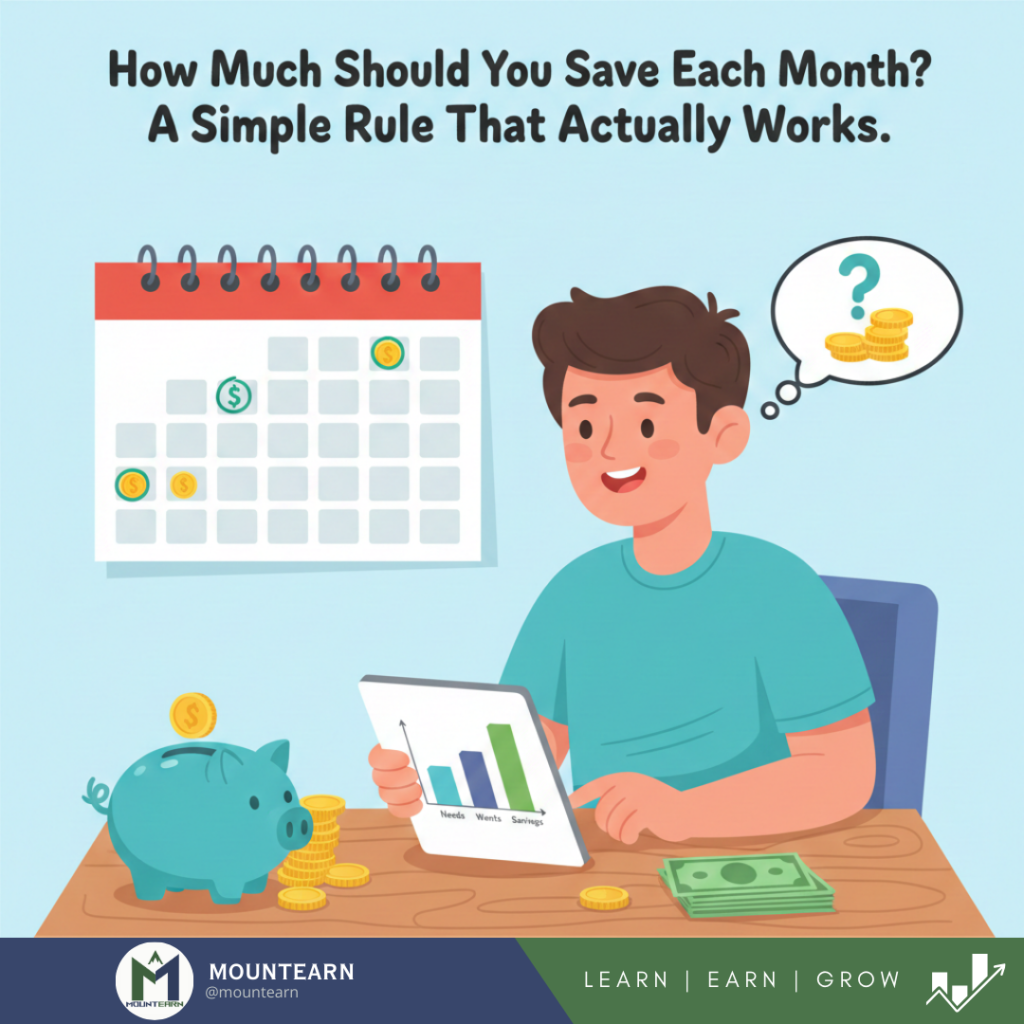
Cartoon illustration of a person at a desk looking at a laptop with a colorful savings chart, coins, piggy bank, and calendar, showing how much should you save each month using a simple rule for beginner-friendly personal finance.

Why Saving Feels So Confusing (How Much Should you Save Each Month)

Most financial advice makes it sound like there is one “magic number” everyone should hit. You’ll hear people scream about saving 20%, 30%, or even 50% of your income. When you’re living paycheck to paycheck or just trying to keep up with rising rent, those numbers don’t feel inspiring—they feel impossible.

The confusion usually stems from three things:

  1. The “All or Nothing” Mentality: We think if we can’t save a huge chunk, there’s no point in saving at all.
  2. Information Overload: One “expert” says to invest, another says to build an emergency fund, and another says to pay off debt first. It’s paralyzing.
  3. The Comparison Trap: We see people on social media showing off their “savings hacks” and feel like we’re already too far behind to start.

Here is the truth: The best monthly savings rule isn’t the one that looks best on a calculator. It’s the one you can actually stick to without wanting to pull your hair out.


The 50/30/20 Rule: Your New Financial Best Friend

If you want a starting point that has stood the test of time, look no further than the 50/30/20 rule. It was popularized by Elizabeth Warren (a law professor before she was a senator), and it’s designed for “everyday people,” not just Wall Street types.

The beauty of this rule is that it doesn’t tell you what to buy; it tells you how to balance your life. Here is the breakdown of your take-home pay (the money that actually hits your bank account):

50% for Needs

These are the non-negotiables. Rent or mortgage, utilities, groceries, insurance, and minimum debt payments. If you stopped paying these, your life would get very difficult very quickly.

30% for Wants

This is the “fun” category. Dining out, Netflix subscriptions, hobbies, that extra-nice coffee, or a new pair of shoes. This category exists so you don’t feel like a robot. Living a life where you never spend on things you enjoy is a recipe for “savings burnout.”

20% for Savings and Debt Repayment

This is the answer to our big question. Under this rule, you aim to put 20% of your income toward your future. This includes building an emergency fund, putting money into a retirement account, or making extra payments on high-interest debt (like credit cards).


Why This Rule Actually Works in Real Life

You might be looking at that 20% and thinking, “That’s still a lot of money.” But here is why this specific framework is so effective for beginners:

1. It Focuses on Ratios, Not Dollars

Whether you make $2,000 a month or $10,000, the percentages stay the same. It scales with you. It acknowledges that as your income grows, your lifestyle might grow a bit, too—but your savings should grow right along with it.

2. It Gives You “Permission” to Spend

Most people fail at saving money because they try to cut out every single ounce of joy. They stop going to movies, they stop seeing friends, and they feel miserable. The 30% “Wants” category is a safety valve. It acknowledges that you are a human being who deserves a life today while planning for tomorrow.

3. It Prioritizes the “Future You”

By setting a target, you stop asking “how much should I save each month?” and start asking “how can I fit my life into these buckets?” It turns saving from an afterthought into a priority.


What If 20% Feels Impossible Right Now?

Let’s get real. If you’re currently saving 0%, jumping straight to 20% is like trying to run a marathon when you haven’t walked around the block in a year. You’re going to get sore, and you’re going to quit.

If your budget is tight, here is how to adjust the rule:

  • The 1% Start: Can you save just 1% of your paycheck? For most people, that’s the cost of one takeout meal. Start there. Once you realize you don’t miss that 1%, move it to 2%.
  • The “Needs” Audit: If your “Needs” (rent, car, etc.) are taking up 70% of your income, you physically cannot save 20% yet. That’s okay. Your goal is to slowly find ways to lower those needs or increase your income over time.
  • The Seasonal Approach: Some months are harder than others (hello, December). It’s okay to save less during expensive months as long as you promise to pick it back up in the “cheaper” months.

Personal finance basics are about progress, not perfection. Saving $20 a month is infinitely better than saving $0 a month.


Common Saving Mistakes Beginners Make (And How to Avoid Them)

Even with a simple rule, it’s easy to trip up. Here are the most common traps people fall into when they start their saving money journey:

1. Saving “What’s Left Over”

If you wait until the end of the month to see what’s left in your account to save, the answer will almost always be zero. Money has a way of disappearing when it’s just sitting in a checking account.

  • The Fix: “Pay yourself first.” Treat your savings like a bill that must be paid as soon as your paycheck hits.

2. Not Having an Emergency Fund First

Many people jump straight into “investing” because they want to see their money grow fast. But if your car breaks down and all your money is locked in an investment account, you’ll end up putting the repair on a credit card.

  • The Fix: Build a “Starter Emergency Fund” of $1,000 (or one month of expenses) before doing anything else. It acts as a shield for your savings.

3. Being Too Restrictive

If you try to live on just rice and beans to hit a high savings goal, you’ll eventually “binge spend” out of frustration.

  • The Fix: Keep that 30% “Wants” category healthy. It’s the secret sauce to long-term success.

Practical Tips to Save Consistently Without Stress

Ready to put the monthly savings rule into action? Here are a few ways to make it feel effortless:

  • Automate Everything: This is the “cheat code” of personal finance. Set up an automatic transfer from your checking account to your savings account for the day after payday. If you don’t see the money, you won’t miss it.
  • Use High-Yield Savings Accounts: Most regular banks pay you pennies in interest. A High-Yield Savings Account (HYSA) can pay significantly more just for letting your money sit there. It’s free money.
  • The “24-Hour Rule”: Before buying something in your “Wants” category that costs more than $50, wait 24 hours. Usually, the impulse fades, and that money stays in your pocket.
  • Track, Don’t Obsess: Use a simple app or a notebook to track where your money goes for one month. Don’t judge yourself; just observe. Knowledge is power.

Your Small Step for Today

Figuring out how much should you save each month isn’t a math problem—it’s a habit problem. You don’t need to be a financial genius to build a secure future; you just need to be consistent.

You don’t have to overhaul your entire life by tomorrow morning. You just need to start.

Here is your one actionable step for today: Open your banking app and look at your total income from last month. Multiply that number by 0.01 (that’s 1%). Does that number feel doable? If yes, set up an automatic transfer for that tiny amount to go into a savings account tomorrow.

You’ve just started. And honestly? Starting is the hardest part.


Check out these

Needs vs Wants: The Simple Rule That Finally Fixed My Spending

I have a secret: I was a financial fraud. Not a criminal, but a self-deceiver.

I knew the difference between needs vs wants. Ask me on a quiz, and I’d ace it. Food is a need; filet mignon is a want. Easy. But then the paycheck would hit my account, and I’d transform into a self-justifying financial lawyer, arguing my case for every single impulse buy. My bank account, bless its digital heart, was the only thing telling the truth: my theoretical knowledge of needs vs wants was utterly useless against my real-world craving for convenience and immediate gratification.

For years, I’d stare at my transactions—the clothing bought in a rush, the excessive takeout, the gadget upgrades—and feel that familiar, nauseating combination of regret and confusion. I was smart enough to earn money, but seemingly too dumb to keep it. The classic needs vs wants framework was failing me because it was too fuzzy. It allowed too much room for my exhausted, highly-marketed-to brain to say, “Technically, this new espresso machine is a need for productivity and saving money on coffee.” (Spoiler: I still bought coffee out.)

My breakthrough wasn’t a sudden influx of cash or a drastic cut in spending; it was a simple, brutal semantic shift. I replaced the moral judgment of needs vs wants with a lens of pure, objective function. This one rule didn’t just explain the difference; it enforced it, without me having to feel guilty.

needs vs wants budgeting examples showing essential expenses like housing, food, transportation, and utilities

The Old Way: The Guilt-Ridden Spending Cycle

Before my revelation, every purchase required exhausting mental Olympics.

  • Scenario 1: New Clothes. My old sweater had a tiny stain. “Do I need a new sweater? Yes! It’s cold, and I need to look professional. A stained sweater is a career risk.” (Walks out with three cashmere blend sweaters and a stylish scarf.) The purchase was justified as a need for warmth and professionalism, but the extra two items and the scarf were pure indulgence. The guilt arrived promptly at the end of the month.
  • Scenario 2: The Latest Gadget. My tablet was three years old. “Do I need the new one? Yes! My old one is slow, and I need to be efficient for work and relaxation. It’s an investment in my well-being.” I spent a huge chunk of savings. I didn’t get faster. I just had a newer, sleeker version of the old device, and the guilt felt heavier than the tablet itself.

The core issue is that the boundary between a life necessity (shelter) and a comfort preference (a fancy, better-located apartment) dissolves when emotions are high. The continuous juggling of needs and wants caused what economists refer to as “decision exhaustion”, which made it ideal for impulsive purchases and a slow decline of my savings objectives.


The Simple Rule: Essential vs. Enhancing

The breakthrough came when I stopped trying to force my wants into the “need” box. I threw out the whole box and started asking a question that requires an answer based on cold, hard reality:

“Does this purchase secure my baseline existence and stability, or does it improve the quality of an existence that is already secure?”

I replaced the loaded, emotional terms of needs vs wants with two purely functional, objective categories: Essential and Enhancing.

1. Essential: The Foundation of Life

An Essential purchase is the absolute bedrock. If you remove it, your safety, health, stability, or ability to earn money is in jeopardy. These are non-negotiable payments to keep the ship afloat.

  • Shelter: The basic rent/mortgage for a safe, modest dwelling. (Not the extravagant view or the second spare room.)
  • Food: Nutritious groceries for basic, sustained meals. (Not the ready-made gourmet dinner kits.)
  • Transportation: The most reliable, affordable method to get to your job. (A bus pass, or the maintenance on a functional car.)
  • Utilities: Heat, water, and basic connectivity (the minimum internet/phone necessary for work and emergencies).

The key here is survival. Notice how the quality, the brand, and the luxury are instantly stripped out of the definition. Baseline function is the only judge.

2. Enhancing: The Spice of Life

An Enhancing purchase is everything that adds comfort, joy, convenience, speed, or status above that essential foundation.

  • Food: Eating out, premium coffee, expensive supplements, organic produce when conventional is adequate.
  • Shelter: A cleaning service, home decor, the choice of a luxury apartment building.
  • Clothing: Designer brands, clothes bought purely for fashion or excessive quantity.
  • Efficiency: The latest phone model when the old one is fine, streaming services, high-end electronics.
  • Experiences: Vacations, concerts, expensive hobbies.

Enhancing items are what make life wonderful—they are not the enemy! But by labeling them honestly, I realized they were the flexible part of my budget, the place I could easily draw funds from to meet my actual savings goals.


How This Filter Works in Real Life

Applying the Essential vs. Enhancing rule removes the emotion and forces clarity.

Purchase ExampleOld Thought (Needs vs Wants)New Thought (Essential vs. Enhancing)Decision Outcome
New Running ShoesNeed. I need to exercise for my health.Essential. My old shoes are actually causing knee pain and will lead to injury if not replaced. (Focus on preventing damage.)Buy (Essential)
Ordering TakeoutNeed. I’m exhausted after work and need to eat.Enhancing. I have perfectly good food in the fridge. This is for convenience and comfort, not survival.Limit/Budget (Enhancing)
A New $400 JacketNeed. My old one is out of style, and I need to look presentable.Enhancing. My current jacket is perfectly warm and functional. This is for status and preference.Delay/Hold (Enhancing)
A New LaptopNeed. My old one is slow; I need efficiency.Essential/Enhancing Mix. I need a functional computer (Essential). The speed and sleek features are Enhancing. Can I upgrade the ram instead of buying new?Compromise (Focus on Essential function)

The Power of Intentional Allocation

This wasn’t about austerity; it was about authority. I didn’t stop spending on the “wants” (Enhancements); I just changed how I paid for them.

  1. Fund the Essentials First: I pay the bare minimum required for a stable life (plus my key savings goals, which I treat as an Essential payment to my future self).
  2. Allocate the Enhancements: What’s left over is explicitly my Enhancement budget. It’s my “fun money.”
  3. No Guilt: When I buy those $400 headphones now, I do it without a shred of guilt. Why? Because I’m paying for it from a budget line specifically created for the joy and improvement of my life, without compromising my foundational needs or my future goals.

This simple reframing of needs vs wants into the clear, objective Essential vs. Enhancing framework changed my life. It took the emotion and the internal debate out of spending and replaced it with clarity and intentionality. It’s the simple rule that finally helped me align my spending with my deepest financial values.


Your Next Step

Grab your last month’s bank statement. Highlight every transaction that was truly Essential for your survival and stability. Everything else is an Enhancement. Look at how much of your money went towards improving your life versus sustaining it.


More Posts

1. The 50/30/20 Budget Rule: Your First Step to Financial Freedom

2. The 7 Biggest Money Mistakes People Make in Their 20s (And How to Fix Them)

14 Grocery Shopping Hacks That Can Cut Your Bill in Half

The Secret to a Smaller Grocery Bill Isn’t a Secret Anymore

Let’s be honest: that trip to the grocery store can feel less like a pleasant chore and more like a financial gut punch. You walk in for milk and bread and walk out $150 lighter, wondering what happened. The rising cost of living means we’re all looking for ways to tighten our belts without resorting to eating only instant noodles.

Good news! The solution isn’t about deprivation; it’s about smart strategy. By employing a few powerful, simple, and effective grocery shopping hacks, you can genuinely reduce your weekly spending by 30%, 40%, or even a whopping 50%.

We’ve compiled 14 of the best-kept secrets—from mastering the grocery store layout to becoming a freezer guru. If you’re ready to stop stressing about the checkout line total, keep reading.

Grocery shopping hacks to save money and cut your grocery bill in half.

Phase 1: The Pre-Shop Prep (Where 50% of the Savings Happen)

The most effective grocery shopping hacks happen before you even set foot in the store. This is your mission control for maximum savings.

1. Master the Meal Plan (The Anchor of Savings)

A meal plan is your single most powerful weapon against impulse buying. Instead of wandering the aisles hoping inspiration strikes, you go in with a surgical list.

  • The Human Touch: Don’t make it a rigid prison. Plan four or five core dinners for the week, and leave two nights for leftovers, a simple pantry meal (like pasta), or a planned “cheat” take-out. This flexibility keeps you sane.
  • The Pro Hack: Plan meals based on what you already own and what’s on sale. Check the sales flyers first, then build your meals around those discounted items (e.g., if chicken breast is cheap, plan for three chicken-based meals).

2. Take a “Pantry Audit” Before Making Your List

How many times have you bought paprika only to find three half-used jars when you got home? We’ve all done it. Before list-making, spend 10 minutes looking into your fridge, freezer, and pantry.

  • The Human Touch: Use the “Eat Me First” strategy. Write down items nearing their expiration date—a lonely bell pepper, a nearly-finished bag of spinach, or that chicken in the freezer—and find a way to incorporate them into your meal plan.
  • The Grocery Shopping Hack: This step directly informs your list, ensuring you only buy true necessities, preventing waste, and saving you money on items you already own.

3. Implement the “Rule of Three” on Your List

Don’t just write “shampoo.” Be specific.

  • The Rule: List the item, the size, and the price goal.
    • Example: Shampoo, 16 oz, must be under $4.00.
  • The Human Touch: This prevents “brand hypnosis.” When you have a price goal, you’re less likely to grab the big-name brand and more likely to look at the store-brand equivalent, often leading to a significant saving for the exact same function.

4. Become a Digital Coupon & Loyalty App Ninja

Paper coupons are passé. Your phone is now your savings hub.

  • The Grocery Shopping Hack: Download the apps for the stores you frequent. Clip digital coupons before you go. Many stores offer personalized deals or a special “free item” just for using the app. Don’t check out until you’re sure you’ve scanned or loaded all applicable deals.

Helpful resource:
👉 Learn how digital coupons work here:


Phase 2: Mastering the Store Environment

The grocery store is designed to make you spend money. Your goal is to navigate their psychological traps like a seasoned veteran.

5. Never, Ever Shop When Hungry

This is a classic for a reason. Hunger triggers your lizard brain to stockpile, making every snack aisle look like a paradise and every impulse buy seem essential.

  • The Human Touch: Have a quick, protein-rich snack—like a handful of nuts or an apple with peanut butter—before you leave. A satisfied stomach leads to a focused mind.

6. Skip the “Eye-Level is Buy-Level” Trap

The priciest items are always placed exactly where your eyes land first—at eye level.

  • The Grocery Shopping Hack: Always look up and look down. The store-brand equivalents and generic items, which are almost always cheaper, are relegated to the bottom and top shelves. A quick squat or stretch can save you a bundle.

7. Befriend the Bulk Bins (With Caution)

Nuts, dried fruits, grains, and spices are often significantly cheaper when purchased from the bulk section.

  • The Human Touch: Only buy what you will realistically use before it spoils. Buying five pounds of obscure flour because it’s cheap is not a hack if half of it ends up getting thrown out six months later.
  • The Pro Hack: Spices are a huge win here! Buy small amounts of less-used spices to keep your spice cabinet fresh and your wallet happy.

8. Ignore the Endcaps

Those displays at the end of the aisles (called endcaps) look like they’re hosting the biggest sales. They rarely are. They’re prime real estate for manufacturers paying a premium to get their product in front of you.

  • The Grocery Shopping Hack: Compare the endcap price to the price of similar items on the actual shelf. Often, the item on the shelf tucked inside the aisle is the better deal.

9. Use the Periphery Rule

The perimeter of the store is where you’ll typically find the essentials: produce, dairy, meat, and bread. The center aisles are mostly processed, packaged, and marked-up goods.

  • The Human Touch: Stick to the edges. Challenge yourself to get 80% of your items from the perimeter to ensure a healthier, less expensive haul.

Helpful resource:
👉 Learn more about “shopping the perimeter” here:


Phase 3: Checkout and Beyond (Maximizing Your Purchase)

These grocery shopping hacks ensure you get the absolute most value out of every item you bring home.

10. Learn the “Unit Price” Metric

Forget the big price tag. The only number that matters is the unit price (e.g., price per ounce, per pound, or per sheet). This small number is usually located beneath the main price.

  • The Grocery Shopping Hack: Always compare unit prices. The giant box of cereal might look like a deal, but a smaller bag of the store brand could have a lower price per ounce. It’s the only way to compare apples to apples.

11. Be a Freezer Guru

The freezer is your personal savings account. Anytime you see a great deal on meat, bread, or even milk (yes, you can freeze milk!), buy extra.

  • The Human Touch: Batch cook! When you’re making chili or a soup, double the recipe. Eat one portion tonight and freeze the rest in individual servings for easy, cheap lunches later. This eliminates the temptation to buy a $15 lunch out.

12. Prioritize Store Brands

This is one of the easiest grocery shopping hacks to implement. The store brand (or private label) is almost always significantly cheaper and often made in the exact same facility as the national brand.

  • The Human Touch: Start small. Challenge yourself to switch three items to the store brand this week—maybe salt, canned beans, and cereal. If you can’t tell the difference, you’ve just locked in a permanent saving.

13. Stop Buying Pre-Cut Produce

Pre-cut fruits (like pineapple spears) and pre-shredded vegetables (like lettuce) come with a premium known as the “Convenience Tax.”

  • The Grocery Shopping Hack: If you have the time, buy the whole item and do the chopping yourself. A head of lettuce is almost always cheaper than a bag of mixed greens. This small effort yields huge savings over time.

14. Embrace the “Clearance” Section

Many stores have a dedicated clearance shelf or cart, often near the back of the produce or meat section, containing items close to their expiration date.

  • The Human Touch: These items are perfectly fine but need to be used that day. Buy them only if you are committed to cooking or freezing them immediately. This is how you snag meat for half-price!

Your Grocery Bill: Half the Cost, Double the Satisfaction

Implementing these 14 grocery shopping hacks might feel like a lot at first, but start small. Master the meal plan, download your store’s app, and always compare the unit price.

You are not just saving money; you are becoming a savvy consumer who is in control of their budget. With a focused strategy, you can walk out of the store knowing you got what you needed for a price you feel good about. That is a kind of satisfaction that is priceless—or, at least, half-price!


Want to improve your monthly money plan?
Check out my guide on the 50/30/20 rule here →

Prefer a hands-on way to control spending?
Learn the Envelope Method (digital + physical version) →

How to Build an Emergency Fund: The 30-Day Plan

Introduction: From ‘What If’ to ‘I Got This’

In this guide, you’ll learn exactly how to build an emergency fund in 30 days using simple, realistic steps anyone can follow.

Let’s be real for a minute. Have you ever gotten that pit-in-your-stomach feeling when your mechanic gives you the number, or you open an envelope from the dentist? That feeling where you mentally calculate how much interest you’ll pay on your credit card just to survive this unexpected hit? Ugh. It’s the worst.

We tend to think financial security is reserved for Wall Street wizards, but honestly, it’s far simpler—and way more accessible. The key isn’t a secret stock tip; it’s the good old Emergency Fund. If you’re ready to make a change, I’m here to show you exactly how to build an emergency fund in 30 days. It’s not a luxury; it’s your personal financial bodyguard, the thing that lets you shrug and say, “I got this, life.

If budgeting scares you, you can also read my post on The Envelope Budgeting System which helps you stay accountable with your money.

Forget the idea that this has to be a slow, painful grind. We are going to sprint. In this next month, we are laying the foundation for a life where unexpected costs don’t trigger a panic attack. Ready to stop crossing your fingers and start building your financial shield? Let’s go.

The 30-Day Blueprint: Building Your Shield

This isn’t just a to-do list; it’s a transformation plan. We’ve broken this colossal task into four manageable weekly missions. Treat each week like a distinct challenge.

Week 1: The Mindset Shift & The Scavenger Hunt (Days 1-7)

The Goal: Define your ‘Why,’ and find your first $100-$300 to seed the fund.

  • Day 1: Define Your Number (And Your ‘Why’): Ditch the fear of the “six months of expenses” rule for now—that’s Level 2. We are setting a Starter Goal: $1,000. That’s your first major milestone, enough to cover most minor life hiccups (a new tire, an unexpected deductible). Now, the crucial part: Why are you doing this? Write it down. Is it to sleep better? To quit living paycheck-to-paycheck? Your ‘Why’ is your emotional fuel. Don’t underestimate this step—it’s what keeps you going when motivation fades.
  • Day 2-3: The Money Scavenger Hunt: Time to become a detective in your own home! We need quick, immediate cash to give the fund a jolt. Look for things that are gathering dust but still hold value. That designer bag you haven’t touched in a year? That old gaming console? List them on Facebook Marketplace or a local consignment app today. This is your seed money. It’s not about becoming a minimalist; it’s about making your dormant stuff work for you.Find items in your home gathering dust. Sell them on Facebook Marketplace or eBay
  • Day 4-5: Taming the Subscriptions: Go through the last three months of bank statements like a hawk. Find every single recurring payment. Spotify, Netflix, that meal prep app you forgot to cancel. Ask yourself: Do I use this more than once a month? Be ruthless. Cancel or pause the non-essentials. If you save $50 this month, transfer that $50 instantly to your fund. It’s the easiest money you’ll ever make.
  • Day 6-7: The Dedicated Home: You wouldn’t store your passport and your dirty laundry in the same place, right? Your emergency fund needs a dedicated, separate home. Open a High-Yield Savings Account (HYSA). Name the account something motivational like “Peace Fund” or “Life Buffer.” Transfer every dollar you found from your scavenger hunt and subscription purge into this new account. Crucial Rule: It must be separate from your everyday checking so you aren’t tempted to dip into it for a pizza night.

Week 2: The Income Turbocharge (Days 8-14)

The Goal: Generate a one-time income boost and solidify your weekly savings commitment.

  • Day 8-10: The Side Hustle Sprint: It’s time for a short, intense burst of effort. Dedicate a few evenings or a weekend morning to earning extra. Walk dogs, deliver food, offer to organize a friend’s garage for cash, or complete quick freelance tasks online. This is not your new career; it’s a financial power-lift designed purely to push you toward that $1,000 goal faster.
  • Day 11-12: The Bill Negotiation Power-Up: Put on your adulting hat and call your phone, cable/internet, and insurance providers. Be polite but firm. Use the magic phrase: “I am looking to lower my monthly payment.” Often, they have unadvertised promotional rates. If you save even $10-$20 a month on three different bills, that’s massive annual savings! Transfer the first month’s savings directly to the fund.
  • Day 13-14: Automate and Forget: This is where we make savings foolproof. Look at how much more you need to hit your $1,000. Divide the remaining amount by the remaining weeks (or even just by 4 for the month). Set up an automatic, weekly transfer from your checking account to your “Peace Fund.” If you don’t see the money in your checking balance, you can’t spend it. Automation is the quiet, unsung hero of successful savers.

Week 3: The Spending Audit & Recalibration (Days 15-21)

The Goal: Identify and permanently plug your biggest “leakage” points.

  • Day 15-17: The Spending Tracker Challenge: For three days, become hyper-aware. Track every single dollar you spend—even the $3 vending machine purchase or the parking meter fee. Don’t judge the purchase; just track the behavior. At the end, highlight everything that was non-essential, and transfer that total amount straight into your fund. Spoiler Alert: We all have “little leaks” that add up fast.
  • Day 18-19: The Food Budget Fix: Let’s tackle the biggest wallet drainer: Food. Challenge yourself to a “No Takeout/Restaurant” Week. Cook strictly with what’s already in your pantry and freezer. The average family can save $100-$200 doing this. Redirect that entire savings into your emergency fund. It’s a great way to be creative and save big simultaneously.
  • Day 20-21: The Savoring Delay: When you get the urge to buy something non-essential (new sneakers, a cool gadget), use the 48-Hour Rule. Put the item in your online cart, walk away, and don’t buy it for two full days. You’ll be shocked how often the desire completely disappears. If you decide you don’t need it, transfer the cost of the item you didn’t buy to your fund.

Week 4: Momentum & The Long Game (Days 22-30)

The Goal: Hit your $1,000 starter goal and map out the path to your full fund.

  • Day 22-25: Re-Budgeting Windfalls: Did you get a tax refund? A small work bonus? A birthday check from Aunt Carol? The old you would have spent it. The new, financially secure you sends at least 50% (if not 100%) straight into the emergency fund. This is how your fund grows exponentially and without pain.
  • Day 26-28: The Full Fund Calculation: You have momentum now! It’s time to set your sights on your True Goal. Tally up your essential monthly expenses (rent/mortgage, insurance, groceries, minimum debt payments). Multiply that number by 3, 4, or 6. This is the ultimate fortress you are building. It turns the daunting goal into a tangible number you can plan for.
  • Day 29: The Fund Check-In: Look at your “Peace Fund.” Celebrate! Seriously, treat yourself to a non-expensive reward. You achieved the absolute hardest part: starting, staying consistent, and gaining real traction. You’re $1,000 richer in cash and confidence.
  • Day 30: The Review and Commitment: You built the foundation. Review your automated savings—is it still running? Re-commit to continuing the process. You are no longer someone who wishes they had an emergency fund—you are someone who has one.

Conclusion: Beyond the 30 Days—The Gift of Freedom

Okay, stop everything. I want you to take a genuine, deep breath. You just spent 30 days doing something genuinely revolutionary for your financial future. It wasn’t always glamorous—maybe you said no to a few lattes, or spent a Saturday morning selling stuff you forgot you owned—but look at the return: you bought back your control.

The most powerful thing you’ve built isn’t just the dollar amount sitting in your bank. It’s the unstoppable habit. You’ve trained your brain to be a financial powerhouse—to prioritize, challenge mindless spending, and act proactively. You’ve changed your default setting from panic to power.

Now, the next time that crisis hits—that flat tire, that sudden vet bill—you won’t feel the crushing shame of debt or the anxiety of borrowing. You’ll simply open your “Peace Fund,” handle it, and move on.

Your journey doesn’t stop here, but the hard part is over. Keep that automatic transfer running. Check in on your spending leaks every season. Before you know it, your $1,000 starter fund will morph into a three-month cushion, then a six-month financial fortress. Remember: The emergency fund isn’t a prison; it’s your parachute.

Congratulations. Go enjoy the profound peace of mind you have absolutely earned.

Now tell me: What was your favorite small win during this 30-day sprint? Drop your success story in the comments below!

The $1,000 Starter Emergency Fund: Why You Need It

The $1,000 Starter Emergency Fund

Emergency Fund Step #1: The Panic of the Unexpected

Tuesday at 5:30 p.m. You hear it as you’re driving home: thump-thump-thump. flat tire . With a sinking heart, you pull over and ask yourself, “How am I going to pay for this?”

A $150 inconvenience is more than just a bother for millions of people; it’s an economic disaster. A minor surprise can completely blow your budget when you’re living paycheck to paycheck. The usual remedy? Credit cards or payday loans. However, that “solution” frequently sets off an endless cycle in which you borrow money, pay interest, and continue to be indebted.

The $1,000 Starter Emergency Fund is important because of this. It’s the first and most crucial step toward financial peace, but it’s not a route to riches. This tiny buffer allows you to take charge when life throws you a curveball and breaks the cycle of debt.

Building your first $1,000 starter emergency fund is the foundation of financial peace. As Dave Ramsey explains in his guide on how to build a $1,000 emergency fund, it’s the first step toward taking control of your money.

Emergency Fund Step #2: What a $1,000 Starter Fund Is (and Isn’t)

You must understand exactly what this fund is and is not before you begin saving.

What It is:

  • a tiny, liquid safety net that is kept in a different savings account.
  • made to handle actual crises, such as urgent home repairs, medical expenses, or auto repairs.
  • a safety net against high-interest debt.

What It Isn’t:

  • It’s not your entire emergency fund for three to six months; that comes later.
  • It’s not a fun money account or an investment.
  • It isn’t for prearranged costs like presents or holidays

Key takeaway: The purpose of this fund is straightforward: it shields you from taking on new debt. Refill it right away before continuing if you use it.

Emergency Fund Step #3: Why $1,000 Is the Magic Number

So, why $1,000? Why not $5,000 or $10,000? Here’s why it works

  • It ends the cycle of debt.

One emergency without cash forces you to use your credit card. You can deal with it and move on stress-free with $1,000.

  • It is possible.

It feels impossible to save $15,000, but it feels possible to save $1,000. That fast victory gives you momentum and confidence.

  • The majority of common emergencies are covered.

90% of life’s small errors can be covered by $1,000, whether it’s a flat tire, an emergency plumber, a medical co-pay, or a home repair.

It’s not about the number itself — it’s about the habit of being prepared.

Emergency Fund Step #4: How to Build Your $1,000 Fund Fast

You don’t need a year to build this. You can do it fast with focus and intensity.

Step 1: Open a Separate Account

Keep it apart from your checking account to avoid temptation.
A high-yield savings account (HYSA) is perfect — it earns interest and takes a day or two to transfer, which adds a “pause” before you spend.

Step 2: Find the Money — Fast

This is a sprint, not a marathon.

  • Sell things you don’t use: old electronics, furniture, clothes.
  • Cut spending temporarily: no takeout, no new clothes, no subscriptions.
  • Increase your income: take extra shifts, do deliveries, freelance online.

Step 3: Make It Automatic

Even $25–$50 a week adds up quickly. Automate transfers straight to your emergency fund so saving happens without thought.

Emergency Fund Step #5: What Happens After You Hit $1,000

Well done! You’ve established your first line of defense against debt, something that most people never do.

What comes next?

  • If you have debt: Start paying it down aggressively (use the debt snowball or avalanche method). Your emergency fund protects you from going backward.
  • If you’re debt-free: Begin growing your full emergency fund — 3 to 6 months of essential expenses.

Either way, that $1,000 means you can handle life with confidence instead of panic.

Emergency Fund Step #6: Your First Step to Financial Peace

The goal of the $1,000 fund is not to become wealthy. It’s about altering how you interact with money. It transforms fear into calm. It stands between you and financial ruin.

You will use your emergency fund instead of a credit card the next time your refrigerator breaks down or your car breaks down.

Begin now.
Get the account open.
Send in your initial $20.
Your financial independence starts there.

it’s smart to understand how to manage your income wisely. Check out our guide on the 50/30/20 Budget Rule to learn how to divide your money effectively.