Zero to $100 in a Week: Beginner-Friendly Side Hustle Challenges

Hey there! If you’ve ever scrolled through social media and seen people claiming they make thousands of dollars a month while sitting on a beach, it’s easy to feel a bit left behind. But let’s keep it real: most of us aren’t looking for a “get rich quick” scheme. We just want a way to pay for that concert ticket, save up for a new laptop, or finally have some extra spending money in our pockets.

Starting from zero can feel overwhelming. Where do you even begin? That’s where beginner side hustle challenges come in. Instead of overthinking a massive business plan, these challenges are designed to be “sprints”—short, actionable tasks that get you to your first $100 fast. Whether you’re a student, a busy teen, or just someone looking for a fresh start, these challenges are the perfect way to break the ice.

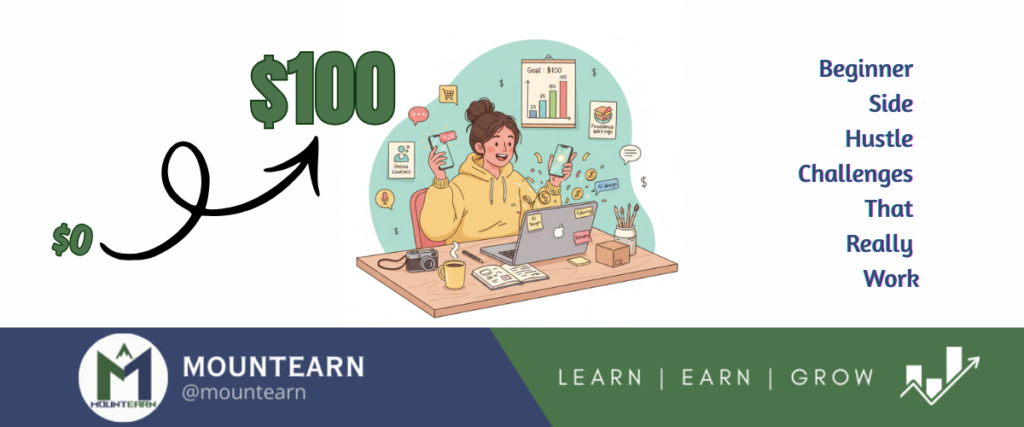
Teen sitting at a desk with laptop and smartphone, completing beginner side hustle challenges to earn $100 in a week, surrounded by symbols of online and offline side hustles like delivery packages, paintbrush, and digital icons.

What Are Beginner Side Hustle Challenges?

Think of a “challenge” as a gamified way to earn money. Instead of a boring job description, these are specific, time-bound tasks. The goal isn’t just the money; it’s the momentum. Once you see that first $20 or $50 hit your account, the “beginner” label starts to fade, and you start thinking like an entrepreneur.

The beauty of beginner side hustle challenges is that they require little to no upfront investment. You’re using what you already have—your time, your skills, or even just the extra stuff sitting in your closet.


Top 10 Beginner Side Hustle Challenges to Earn $100 in a Week

Ready to hit that $100 goal? Here are 10 practical ways to jumpstart your earnings. Mix and match them to reach your target by Sunday!

1. The “Closet Cleanout” Challenge

The fastest way to $100 is often sitting right behind you. We all have clothes we don’t wear or gadgets we don’t use.

  • The Goal: List 5-10 items on platforms like Poshmark, Depop, or Facebook Marketplace.
  • Pro Tip: Take photos in natural light. Good lighting can be the difference between a $5 sale and a $25 sale.

2. The User Testing Sprint

Companies will literally pay you to click around their websites and tell them what’s confusing.

  • The Goal: Sign up for sites like UserTesting or TryMyUI and complete 3-5 tests.
  • Why it works: These usually pay about $10 for a 20-minute session. It’s one of the most straightforward beginner side hustle challenges for anyone with a laptop and a microphone.

3. The Neighborhood “Service” Hustle

Don’t underestimate the power of your local neighborhood.

  • The Goal: Post on Nextdoor or a local Facebook group offering to pull weeds, wash cars, or scoop snow for a flat $20 fee.
  • The Math: Just five neighbors saying “yes” gets you to that $100 mark in a single weekend.

4. The Digital Declutter (Selling Old Tech)

Old iPhones, video game controllers, or even textbooks can be turned into instant cash.

  • The Goal: Take your old tech to a Buy-Back store or list it on eBay.
  • Warning: Be honest about the condition. In beginner side hustle challenges, your reputation (and your rating) is everything.

5. The Micro-Task Marathon

If you have small pockets of time during your commute or between classes, micro-tasks are your best friend.

  • The Goal: Use apps like Amazon Mechanical Turk or Clickworker to complete data entry or image tagging.
  • Pro Tip: These pay small amounts, so the “challenge” is to see how many you can stack in an hour.

6. The “Pet Sitter” Weekend

People love their pets, but they don’t always love walking them in the rain or finding a kennel when they go away for a night.

  • The Goal: Create a profile on Rover or just tell your neighbors you’re available for dog walking.
  • The Math: Two dog walks a day at $15 each will get you over $100 in a week easily.

7. The Canva Creator Challenge

Are you good at making things look pretty on social media? Small business owners often struggle with this.

  • The Goal: Create 5 Instagram post templates on Canva and offer them to a local business for $20.
  • Why it works: It provides immediate value and solves a problem they likely hate dealing with.

8. The Voice-Over Venture

You don’t need a professional studio to start. If you have a quiet room and a decent smartphone, you can narrate short clips.

  • The Goal: Check out sites like Fiverr and offer “Intro/Outro” voiceovers for podcasts.
  • Friendly Advice: Focus on being clear and enthusiastic. This is one of those beginner side hustle challenges that can actually turn into a long-term freelance career.

9. The Transcription Trek

If you’re a fast typer, you can turn audio into text.

  • The Goal: Sign up for Rev or TranscribeMe and finish your first 3 hours of audio.
  • Pro Tip: Use noise-canceling headphones to stay focused and increase your speed.

10. The Mystery Shopper Mission

Believe it or not, people get paid to go to stores, buy a coffee, and report on the cleanliness of the bathroom or the friendliness of the staff.

  • The Goal: Download an app like Field Agent or PrestoMap and complete two missions near you.
  • The Perk: You often get reimbursed for the item you buy plus a small fee!

Tips to Succeed in Beginner Side Hustle Challenges

Starting a side hustle is exciting, but it’s also easy to get distracted or discouraged. To make sure you actually hit that $100 goal, keep these tips in mind:

Watch Out for Scams

One of the biggest beginner side hustle challenges is navigating the “too good to be true” offers. If a site asks you to pay money to start working, or if they promise $500 for an hour of work with no skills required, it’s likely a scam. Stick to reputable platforms and never give out your social security number or bank details to unverified sources.

Manage Your Time Like a Pro

You don’t need 40 hours a week to make this work. You just need “focused” time. Set a timer for 30 minutes, put your phone on “Do Not Disturb,” and grind out your challenge. Consistency beats intensity every single time.

Track Your Progress

Write down every dollar you earn. There’s something incredibly motivating about seeing your total go from $0 to $12 to $45. Use a simple notebook or a notes app on your phone. When you see how close you are to $100, you’ll be much more likely to push through the “lazy” days.

Over-Deliver on Value

Whether you’re walking a dog or designing a graphic, do a little extra. Send a photo of the happy dog to the owner. Format the graphic in two different sizes. This leads to tips and repeat customers, making future beginner side hustle challenges much easier.


Why These Challenges Matter

You might think, “It’s just $100, why bother?” But here’s the secret: it’s never just about the $100. These beginner side hustle challenges teach you how to market yourself, how to talk to “customers,” and how to manage your own time. They build the “earning muscle.” Once you know you can make $100 on your own terms, you realize you can eventually make $1,000 or $10,000.

The biggest hurdle is always just getting started. We spend so much time researching “how to make money” that we forget to actually make the money. These challenges force you to stop researching and start doing.


Conclusion: Take the Leap Today!

You’ve got the list, you’ve got the tips, and you’ve got the goal. Now, it’s time to move from “thinking” to “doing.” Remember, the “Zero to $100 in a Week” goal is totally doable if you pick just one or two of these beginner side hustle challenges and commit to them.

Don’t wait for the “perfect” time. Start the Closet Cleanout tonight. Sign up for a user testing site during your lunch break. Your future self (and your bank account) will thank you!

I want to hear from you! Which of these challenges are you going to try first? Or do you have a creative side hustle idea of your own? Share your results or your plans in the comments below! Let’s help each other hit that $100 goal this week! 🚀


More Posts

  1. Financial Planning for 2026 Made Easy: Your Step-by-Step Checklist
  2. The Silent Money Leaks Draining Your Bank Account (And How to Stop Them)
  3. 3 Easy Ways to Make Extra Money 2026: AI Jobs, UGC, and More

If you love photo editing : check out these

3 Easy Ways to Make Extra Money 2026: AI Jobs, UGC, and More

Make extra money 2026, Let’s be honest for a second. Everything is expensive right now. Whether you are staring at your grocery receipt in disbelief or wondering how your streaming subscriptions climbed another five dollars this month, the pressure is real. It feels like every time you scroll through social media, you see people living “the dream” while you’re just trying to figure out how to cover a car repair without dipping into your emergency fund.

If you’ve looked into how to make extra money 2026, you’ve probably run into a wall of jargon. Crypto, “passive” income that takes two years to build, or complex trading schemes that feel more like gambling. It’s overwhelming. Most of us don’t want a second career; we just want a way to pay for a vacation or put some extra breathing room in our bank accounts.

The good news is that the world of work has shifted. You don’t need a specialized degree or ten years of tech experience to find a flexible income. You just need to know where the actual demand is.

In 2026, the demand is in three specific areas: making AI sound more human, creating simple videos for brands, and helping tech companies “grade” their software. These aren’t get-rich-quick schemes. They’re actual jobs that need doing.

3 easy ways to make extra money  2026 split-screen showing AI humanizer, UGC creator, and AI trainer for flexible online income.

Why Extra Income Feels Necessary in 2026

If you feel like you’re running a race where the finish line keeps moving, you aren’t alone. Financial pressure has reached a point where a single full-time salary often isn’t enough to feel truly comfortable.

Rising costs for housing and essentials have made the “side hustle” less of a hobby and more of a strategy for survival. Plus, there’s the mental load. We are constantly exposed to lifestyles that feel out of reach, making us feel like we’re falling behind.

Starting a side hustle idea isn’t about being greedy; it’s about reclaiming some control over your time and your stress levels. Here are three ways to do exactly that.


Method 1: AI Humanizer (make extra money 2026)

You’ve probably read an article lately that felt… off. It was technically correct, but it sounded like a robot wrote it. That’s because a robot probably did. While AI is great at gathering facts, it’s notoriously bad at having a personality.

An AI Humanizer is someone who takes AI-generated drafts and gives them a “soul.” You aren’t writing from scratch. You’re taking a stiff, boring paragraph and rewriting it so it sounds like it’s coming from a real person.

How it works

Companies are pumping out content faster than ever using AI, but they know that if it sounds robotic, people won’t read it. They hire “humanizers” to fix the tone, add personal anecdotes, and ensure the flow is natural.

  • Pay Range: Typically $30–$50 per hour depending on the complexity of the topic.
  • How to start: Look for “Content Editor” or “AI Content Refiner” roles on platforms like Upwork, Reedsy, or specialized content agencies.
  • Expectation: You need a good grasp of conversational English. If you can write a decent email or a clear social media post, you can do this.

This is a perfect online earning path for 2026 because as the web gets flooded with AI junk, the value of “human-sounding” content is skyrocketing.


Method 2: UGC Creator

You don’t need to be a famous influencer with a million followers to make money from video. In fact, brands in 2026 actually prefer people who look and act like regular humans. This is called User-Generated Content (UGC).

A UGC creator makes short, simple videos for a brand to use on their own social media pages. You don’t post these on your account. You send the file to the brand, they pay you, and you’re done.

Why brands love it

Corporate commercials feel fake. A video of a real person in their kitchen showing how a new blender actually works feels like a recommendation from a friend. That’s what sells products now.

  • Pay Range: A beginner can easily charge $100 per 30-second video. As you get better, that goes up.
  • How to start: Grab a product you already own. Film a 60-second review or “unboxing” on your phone. Put 3–5 of these together in a basic portfolio (use a free tool like Canva) and start pitching to brands on platforms like Insense or Billo.
  • Pro tip: Don’t worry about fancy lighting. Natural light from a window and a clear voice are all you really need to get your first check.

Method 3: AI Trainer

If the idea of “teaching” a computer sounds like something out of a sci-fi movie, don’t worry. It’s actually quite boring, which is why it pays well. AI jobs aren’t just for engineers; they’re for people with common sense.

Big tech companies need humans to “grade” the answers their AI models give. If an AI is asked a question and gives two different answers, a human (you) looks at both and decides which one is more helpful, accurate, and safe.

The role of a trainer

You are essentially a quality control officer. You’ll be given a set of guidelines and a dashboard of AI responses. Your job is to click through and rank them based on how well they followed instructions.

  • Pay Range: Generally starts around $25/hr. The work is usually completely flexible—you log in when you have time and log off when you’re done.
  • How to start: Keep an eye on companies like DataAnnotation.tech, Remotasks, or Outlier. They often have entry-level exams. If you pass, you can start working immediately.
  • Why demand is growing: Every tech giant is in a race to have the best AI. They can’t do that without millions of human “votes” to tell the machine what it’s doing right.

Tips to Maximize Your Earnings

It is easy to get excited and try to do all three of these at once. Don’t. That is the fastest way to burn out and end up with $0.

  1. Pick one and commit: Spend two weeks focusing only on one method. See if you actually like the work before moving to the next.
  2. Set a schedule: Even if it’s just 30 minutes after dinner, consistency is what builds an actual income stream.
  3. Track your numbers: Keep a simple list of how much time you spent and how much you made. It helps you realize which jobs are actually worth your time.
  4. Skills over luck: Don’t just “do” the work; try to get slightly better at it each week. A better UGC portfolio leads to higher-paying brands.

Signs You’re Not Using These Opportunities Effectively

Sometimes we “work” without actually making money. If you find yourself doing the following, it might be time to pivot:

  • The Search Loop: You spend three hours reading “how-to” guides but never actually apply for a single job.
  • The Inconsistency Trap: You work for five hours on a Sunday and then don’t touch it for three weeks. These platforms reward people who show up regularly.
  • Chasing the Hype: If you drop a solid AI training gig because you heard someone made $10,000 in a week doing something else, stop. Stick to what is actually hitting your bank account.

Final Thoughts

Making extra money in 2026 isn’t about being a genius or having a “hustle harder” mindset. It’s about looking at where companies are currently spending their money and positioning yourself to help them.

Whether you choose to be a UGC creator, an AI trainer, or a humanizer, the goal is the same: to give yourself a little more financial freedom without losing your mind in the process. You don’t need a massive plan. You just need to start.

Pick one method, try it consistently for a while, and watch your income grow in 2026.


More Posts

If you want make extra money 2026 check out these also:

  1. Stop Chasing More Income Until You Fix This First
  2. A Simple 10-Minute Weekly Money Routine That Changed Everything
  3. How Much Should You Save Each Month? A Simple Rule That Actually Works

If you’re interested in photo editing: check these out

Online vs Offline Side Hustles: Which Makes More Money in 2025?

When it comes to online vs offline side hustles, everyone is looking for that “magic” answer. We’ve all seen the TikToks of people making $10k a month selling digital planners from a beach in Bali, and we’ve also seen the “sweaty startup” gurus on Twitter claiming they bought a Ferrari just by pressure-washing driveways in the suburbs.

It’s easy to get caught in the middle, paralyzed by the “What Ifs.” What if I spend months building a blog that nobody reads? What if I buy a lawnmower and can’t find a single client?

In 2025, the side hustle landscape has shifted. The “easy” money has dried up, replaced by a need for genuine value. Whether you’re trying to kill off a credit card balance or building a bridge to quit your day job, let’s get real about where the money is actually flowing.

Illustration showing online vs offline side hustles with digital and traditional ways to earn money

The Digital Dream: Online Side Hustles

The appeal of online work is obvious: you can work in your sweatpants, the commute is ten feet, and your potential customer base is roughly 5 billion people. But the “online vs offline side hustles” debate isn’t just about comfort; it’s about leverage.

The Infinite Scale of the Internet

The biggest argument for going digital is that you can decouple your time from your income. If you write an eBook or design a specialized budget tracker, it costs you the same amount of effort to sell it to one person as it does to 1,000 people.

The High-Earners in 2025:

  • Specialized Freelancing: We aren’t talking about $5 logos on Fiverr. We’re talking about AI implementation consultants, technical ghostwriters, and high-level video editors. These roles easily command $75 to $150 per hour. Platforms like Toptal and Upwork’s expert marketplace highlight how specialized freelancers earn premium rates:
  • Micro-SaaS and Tools: Small, “boring” software solutions that solve one specific problem for small businesses.
  • Curated Newsletters: Building a deep connection with a specific niche (like “tech for farmers” or “AI for lawyers”) and monetizing via sponsorships.

The Human Reality of Online Work

The downside? It can be incredibly lonely. You are staring at a screen, fighting algorithms that change every Tuesday, and competing with people in countries where the cost of living is 1/10th of yours. To win online, you don’t just have to be good; you have to be unique.


The Local Powerhouse: Offline Side Hustles

While the world rushed toward the internet, the physical world got neglected. This has created a massive opportunity. In 2025, finding a reliable person to clean a gutter or watch a dog is like finding a needle in a haystack. Because demand is high and supply is low, “offline” prices have skyrocketed.

The “No-Competition” Zone

When you compare online vs offline side hustles, the offline world wins on “speed to dollar.” If you post in a local neighborhood app that you’re available for mobile car detailing this Saturday, you could have $300 in your pocket by sunset. You aren’t competing with a guy in another country; you’re only competing with the three other people in your zip code who own a bucket and a vacuum.

The High-Earners in 2025:

  • The “Sweaty” Startups: Window cleaning, power washing, and junk removal. These aren’t glamorous, but they are high-margin. A two-man crew with a truck can easily net $800 a day.
  • Pet and Home Care: As people return to the office, the demand for premium pet sitting and “house sitting” has exploded. It’s low-stress and high-trust.
  • Specialized Lessons: Teaching a physical skill—pickleball, guitar, or even sourdough baking—in person commands a premium because of the human connection.

The Human Reality of Offline Work

The downside here is physical. If you get sick, the money stops. If your car breaks down, your business shuts down. It’s also harder to “scale.” To double your income, you usually have to work double the hours or hire someone else, which brings a whole new set of headaches.


The Financial Breakdown: A Realistic Comparison

MetricOnline HustlesOffline Hustles
Startup CostLow. Often just a laptop and an internet connection.Moderate. Usually requires tools, gas, or equipment.
Time to First DollarSlow. Can take months to build trust or an audience.Fast. Usually within 24–72 hours of starting.
Income CeilingUnlimited. Digital products can scale to millions.Capped. Limited by your physical time and location.
Stress LevelMental. Screen fatigue and “always-on” dopamine loops.Physical. Back aches and travel time.

The “Middle Way”: The Hybrid Model

If you really want to win the online vs offline side hustles game, the secret is not to choose one, but to combine them.

The most successful “hustlers” I know in 2025 use the Offline-to-Online Pipeline. 1. Start Offline: They start by doing something physical (like specialized garden consulting). This generates immediate cash and real-world expertise. 2. Move Online: They take the photos, the “how-to” tips, and the client testimonials from that physical work and turn it into a digital course or a paid newsletter.

By doing this, you get the quick cash of the offline world and the long-term wealth of the online world.


Which One Is Right for You?

Before you pick, ask yourself three “human” questions:

  1. What is my “Energy Gap”? If you work a 9-to-5 desk job, the last thing you want to do is spend another four hours at a desk. An offline hustle (like dog walking) might actually feel like a mental vacation.
  2. How fast do I need the money? If you need to pay a bill by next Friday, stop looking for “passive income” online. Go find a physical task that needs doing.
  3. Do I like people? Online work is about traffic; offline work is about relationships. If you’re an introvert, the screen is your friend. If you’re a “people person,” you’re leaving money on the table by not working in your local community.

Final Thoughts: The Cost of Doing Nothing

The “online vs offline side hustles” debate often misses the most important point: the most expensive side hustle is the one you never start.

The internet is full of “perfect” plans, but the real world (and your bank account) only rewards action. Whether you decide to build a digital empire from your couch or become the go-to house sitter in your neighborhood, the key is to start small.

Spend $0. Spend 5 hours. See if you like the “flavor” of the work. If you don’t, pivot. In 2025, your ability to learn a new skill and market it—whether via a Google ad or a flyer on a coffee shop bulletin board—is the ultimate superpower.


More Posts

  1. Needs vs Wants: The Simple Rule That Finally Fixed My Spending
  2. 14 Grocery Shopping Hacks That Can Cut Your Bill in Half
  3. The 50/30/20 Budget Rule: Your First Step to Financial Freedom

Soft Skills for Career Growth: The Underrated Abilities That Will Make You More Money in the Future

Have you ever looked at a colleague—maybe one who isn’t the most technical whiz in the office—and wondered why they keep getting the promotions and the biggest raises? You crunch the numbers, you write the code, you know the policy backward and forward, but they seem to be the one on the fast track to financial freedom.

The truth is, while hard skills get your foot in the door, it’s soft skills for career growth that open the vault.

In a world increasingly driven by automation and AI, the skills that machines can’t replicate—our uniquely human abilities—are quickly becoming the most valuable, and the most highly compensated. This isn’t just about being a “nice person” at work; it’s about mastering a set of high-leverage interpersonal and emotional competencies that drive organizational success, and in turn, dramatically increase your personal income.

If you’re serious about your personal finance journey, you need to stop viewing your soft skills as a fluffy “nice-to-have” and start treating them as a core, high-return investment in your future earning potential. Think of this as the Human Capital section of your financial portfolio.

Here are the four essential soft skills you must master now to make significantly more money in the future.

Soft Skills for Career Growth: The Underrated Abilities That Will Make You More Money in the Future

1. The Art of High-Stakes Communication (Beyond Just Talking)

When most people think of communication, they think of clear emails and confident presentations. But high-value communication is so much more: it’s the ability to translate complex ideas into simple, actionable language for any audience, from a client to a CEO. This is the skill of influence.

The Financial Impact

The people who get paid the most are often those who can bridge the gap between technical expertise and strategic decision-making.

  • For the Software Developer: Can you explain to the Sales team why a new feature will solve a customer’s pain point in terms of revenue, not just code?
  • For the Accountant: Can you present the quarterly financial statements to the leadership team in a story-driven narrative that highlights future opportunities, instead of just reading lines off a spreadsheet?

This high-stakes communication skill is what allows you to successfully negotiate your salary, advocate for your project’s funding, and build the cross-departmental relationships that sponsor your promotion. It’s the difference between being a specialist who is told what to do, and a leader who helps decide what needs to be done.

How to Invest in This Skill

Don’t wait for a huge meeting. Practice simplifying jargon in everyday conversations. When you’re explaining something to a friend or family member, force yourself to use simple analogies. Join a group like Toastmasters, or volunteer to lead a meeting where you have to clearly define the “why” before diving into the “how.”


2. Emotional Intelligence (EQ): The True Currency of Leadership

Emotional intelligence is your capacity to understand and manage your own emotions, and to recognize and influence the emotions of others. While an AI can calculate a risk, only a human with high EQ can manage the fear and uncertainty of a team navigating that risk.

The Financial Impact

High EQ translates directly into higher pay because it is the fundamental building block of effective leadership and team performance.

  • Conflict Resolution: Leaders with high EQ can de-escalate tension, turning a destructive workplace argument into a productive problem-solving session. This saves the company time, morale, and ultimately, money.
  • Resilience and Adaptability: In a world of constant economic and technological change, those who can manage their own stress and maintain a calm, focused presence under pressure are invaluable. They don’t panic when the market crashes; they pivot. Companies pay a premium for stability in the face of chaos.
  • Empathy and Trust: People work harder, smarter, and stay longer for managers who show genuine empathy. Low employee turnover is a huge cost saving, and companies recognize (and reward) the leaders who create that trusting environment.

Studies consistently show that EQ is a stronger predictor of job performance and income than technical skills or even IQ. The higher up the corporate ladder you climb, the more critical EQ becomes.

How to Invest in This Skill

Start with self-awareness. Keep a journal of your emotional reactions to work situations. When something frustrates you, pause. Ask: Why am I feeling this way? What is the real trigger? Then, practice empathy. Before reacting to a colleague’s delay or mistake, ask an open-ended question to understand their situation: “It sounds like you’re facing a tough deadline—what’s the biggest blocker right now?”


3. Critical Thinking & Creative Problem Solving: The Solution Multiplier

In the future, the routine problems will be solved by algorithms. The million-dollar problems—the ones that unlock new revenue streams or save a company from disaster—will require human critical thinking and creativity. This soft skill is the ability to see around corners and connect disparate ideas to form a novel solution.

The Financial Impact

You are paid based on the difficulty of the problems you solve. The person who can identify an issue three steps before it becomes a crisis is more valuable than the person who can only fix it after the fact.

  • Identifying Opportunities: Critical thinkers don’t just follow instructions; they question the status quo. They look at the current budget, the existing process, or the product lineup and ask, “Is there a better, more profitable way to do this?” This mindset directly leads to innovation and efficiency gains, which are the lifeblood of high-growth careers.
  • Data Synthesis: In a data-saturated world, the soft skill isn’t running the analysis (a machine can do that); it’s determining which data matters, interpreting its real-world implications, and using it to formulate a strategic recommendation.

Being a proactive problem-solver makes you an indispensable asset. Indispensable assets have leverage. Leverage means higher pay.

How to Invest in This Skill

Whenever a decision is made at work, practice the “Five Whys” technique to drill down to the root cause. Don’t stop at the surface-level answer. Engage in activities outside of your niche that force creative connection, like learning a musical instrument or picking up a complex strategy game. Challenge yourself to come up with three radically different solutions to a single problem before settling on the most obvious one.


4. Adaptability and the Growth Mindset: Future-Proofing Your Income

The only constant in the future is change. New technologies, new markets, and new financial realities will continually disrupt industries. The soft skill of adaptability—fueled by a growth mindset—is your shield and sword against obsolescence.

The Financial Impact

A fixed-mindset person sees a new technology (like Generative AI) as a threat that will eliminate their job. An adaptable, growth-mindset person sees it as a tool to increase their productivity and value.(What is Generative AI?)

  • Rapid Upskilling: The adaptable worker is not defined by their last role, but by their capacity to learn the next one. They are the first to volunteer for a pilot program, the first to teach themselves a new tool, and the first to integrate a new workflow. This continuous relearning makes them valuable in any economic climate and in any department.
  • Proving Value in Transition: When companies merge, downsize, or pivot, the most adaptable people are the ones who are retained and promoted. They are seen as the steady hands capable of navigating the turmoil and guiding others through the change.

In a rapidly changing financial landscape, your flexibility is literally your greatest financial security.

How to Invest in This Skill

Embrace uncomfortable learning. Take on a project that you know very little about. Actively seek out constructive criticism (feedback is the fuel of the growth mindset) and view mistakes not as personal failures, but as essential data points for improvement. The next time you face a work challenge, reframe the thought: Instead of saying, “I can’t do this,” ask, “How can I figure this out?”


Your Personal Finance Action Plan

You can’t deposit “Collaboration” into your savings account, but mastering these soft skills for career growth is the single most powerful way to guarantee a continuous, upward trajectory for your income.

Think of it this way: your hard skills are your engine, but your soft skills are the sophisticated steering system, the turbocharger, and the GPS. They dictate the speed, direction, and ultimate destination of your financial journey.

Start small, but start now: Pick one soft skill from this list. Spend the next 30 days focusing on conscious practice. Write down a goal—like, “I will use active listening in every team meeting and summarize what I heard before offering my opinion.” You will be shocked at how quickly this dedicated effort begins to pay dividends, not just in job satisfaction, but in the most tangible way possible: your paycheck.


More Posts

  1. The 50/30/20 Budget Rule: Your First Step to Financial Freedom
  2. 5 Budgeting Mistakes That Keep You Broke (and How to Fix Them)
  3. The $1,000 Starter Emergency Fund: Why You Need It