

5 Critical Financial Red Flags You Must Fix Before It’s Too Late
The “Check Engine” Lights of Your Financial Life
Financial red flags are often subtle, quiet warnings that pop up long before a crisis hits, much like the “check engine” light on your car’s dashboard.
Imagine you are driving down the highway, music blasting, singing along. Suddenly, that little orange light flickers on.
What do you do?
Do you pull over immediately? Do you make a mental note to call the mechanic? Or, if we are being totally honest, do you turn up the radio to drown out any weird noises and hope the light just… goes away on its own?
Most of us are guilty of the latter. We treat our money the exact same way.
When finances get tight or confusing, our instinct is often to look away. We avoid our bank accounts, ignore the mounting credit card balance, and tell ourselves we will deal with it “when things settle down.” But ignoring these financial red flags usually leads to a breakdown that costs ten times more to fix than the original problem.
Financial ruin rarely happens overnight. It usually starts with specific behaviors and patterns. If you can spot them early, you can pivot before the damage becomes permanent.
Here are five major financial red flags you might be ignoring, and exactly how to fix them with your dignity intact.
Financial Red Flags #1: The “Ostrich Effect” (You’re Scared to Check Your Bank Account)
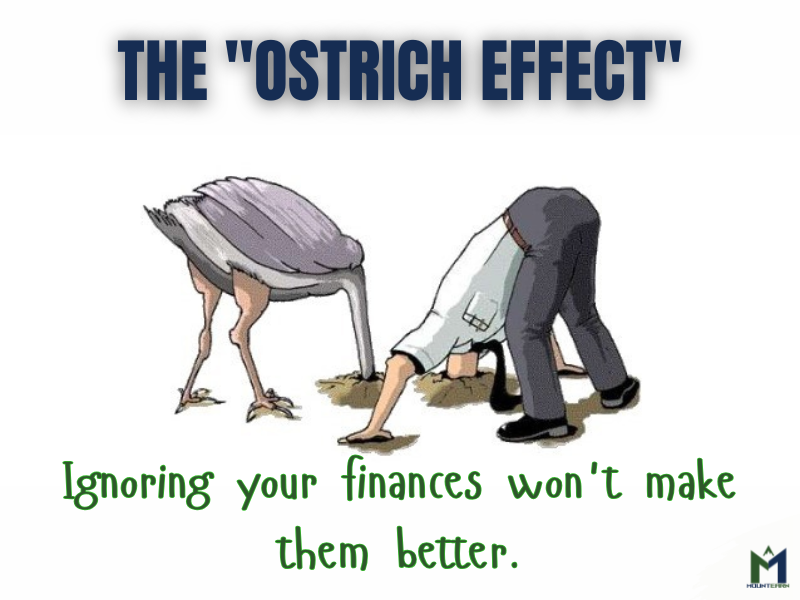
We have all been there. You swipe your card at the grocery store, and for a split second, your heart stops. You aren’t actually sure if the transaction will go through. You haven’t logged into your banking app in weeks because looking at the number makes you physically nauseous.
This is the “Ostrich Effect”—burying your head in the sand.
Why it’s dangerous: You cannot manage what you do not measure. If you don’t know what’s coming in and going out, you are flying blind. This behavior usually indicates that you subconsciously know you are overspending, but you are avoiding the guilt that comes with confirming it.
How to Fix It: You need to demystify the monster.
- Schedule a “Money Date”: Pour a glass of wine, make a coffee, or put on your favorite playlist. Sit down for 15 minutes and just look. No judging, just looking.
- Automate the Alerts: If logging in is too scary, set up your bank app to text you your balance every morning. It forces you to face reality in small, manageable doses.
- Forgive Yourself: Shame is the enemy of progress. You checked the balance. It wasn’t great. You are still alive. Now, move forward.
Financial Red Flags #2: You Use Credit Cards to Pay for Essentials
There is a massive difference between using a credit card to get airline miles and using a credit card because you have zero dollars in your checking account.
If you are swiping plastic to buy milk, eggs, gas, or pay the electric bill—and you do not have the cash to pay that bill off in full at the end of the month—you are living beyond your means. This is a mathematical fact. You are borrowing from your future self to pay for your present survival.
Why it’s dangerous: This creates a “debt spiral.” You charge groceries this month. Next month, you have to pay for those groceries plus interest, which leaves you less money for next month’s groceries, so you charge them again. According to Investopedia’s Guide to Debt Spirals, high-interest debt is the single biggest barrier to building wealth because compound interest works against you, not for you.
How to Fix It:
- Perform Plastic Surgery: Leave the cards at home. Delete them from your auto-fill on your browser. Remove them from Apple Pay.
- Switch to Cash/Debit: It hurts more to hand over cash than to swipe a card. This is psychological friction, and you need it right now.
- Audit the “Essentials”: If you can’t afford food without credit, you have an income problem or a spending problem. Look at your budget. Can you cut subscriptions? Do you need to pick up a side hustle temporarily?
Financial Red Flags #3: You Can’t Handle a $500 Emergency
If your car broke down today and the mechanic said, “That’ll be $500,” would you panic?
According to recent studies, a terrifying percentage of adults cannot cover a $500 emergency without selling something or borrowing money. Living without a financial cushion is like walking a tightrope without a net. You might make it across fine for a while, but one gust of wind (a medical bill, a flat tire, a broken furnace) will knock you off.
Why it’s dangerous: Without an emergency fund, every minor inconvenience becomes a major financial crisis. This forces you back to Red Flag #2 (using credit cards), adding high-interest debt on top of your emergency.
How to Fix It:
- Start Small: Forget the advice about saving “3 to 6 months of expenses” for a moment. That number is too big and discouraging. Aim for $1,000.
- The “Change Jar” Method: If you can’t squeeze money out of your paycheck, sell things. Old clothes, electronics, furniture.
- Automate $20: Set up an auto-transfer of $20 a week to a savings account at a different bank so you don’t see it. You won’t miss $20, but in a year, you’ll have your emergency fund.
Financial Red Flags #4: Your Lifestyle Costs Rise Every Time Your Income Does
Remember when you were a student or just starting out? You likely lived on very little money. You ate ramen, had roommates, and drove a clunker.
Now, you probably make more money. But somehow, you still feel broke. Why? Because every time you got a raise, you “upgraded.” Nicer car, bigger apartment, better clothes, pricier cocktails. This is called Lifestyle Inflation.
Why it’s dangerous: If your spending always matches your income, you will never build wealth. It doesn’t matter if you make $50,000 or $250,000; if you spend it all, you are still living paycheck to paycheck. You are running on a treadmill—working harder and harder but never actually moving forward.
How to Fix It:
- Bank the Raises: The next time you get a bonus or a raise, pretend it didn’t happen. Direct that extra money immediately into savings or investments.
- Define “Enough”: Stop looking at what your neighbors or Instagram friends are buying. Decide what makes you happy, and cut spending mercilessly on the things that don’t.
Financial Red Flags #5: You Justify “Wants” as “Needs”
Our brains are excellent lawyers. We can rationalize almost any purchase if we try hard enough.
- “I need this $6 latte because I had a hard morning.”
- “I need this new outfit because I have a presentation at work.”
- “I need the newest iPhone because the camera is better for taking photos of my dog.”
We blur the line between survival (food, shelter, basic clothing) and comfort.
Why it’s dangerous: This mindset causes “death by a thousand cuts.” It’s rarely one big purchase that ruins a budget; it’s the slow drip of $10, $20, and $50 purchases that we rationalized as necessary.
How to Fix It:
- The 48-Hour Rule: If you see something you want to buy (that isn’t food or medicine), wait 48 hours. Leave it in the online cart. Walk away from the store. If you still desperately want it two days later, then consider it. Usually, the urge passes.
- Calculate in Hours: If you make $20 an hour and you want a $100 pair of shoes, ask yourself: “Are these shoes worth five hours of sitting in a meeting or standing on my feet?” Often, the answer is no.
The Bottom Line: It’s About Progress, Not Perfection
If you read through this list and recognized yourself in one (or all) of these red flags, take a deep breath. You are not a failure. You are human.
Money is emotional. It is tied to our safety, our status, and our survival. It is normal to make mistakes. But now that you see the warning lights on the dashboard, you have a choice. You can keep driving until the engine smokes, or you can pull over, pop the hood, and start making repairs.
Fixing these red flags won’t happen overnight. It might take months to build that emergency fund or pay off that card. That’s okay. The goal isn’t to be perfect tomorrow; the goal is to be a little bit more secure today than you were yesterday.
You’ve got this.
“Lifestyle upgrades feel normal, but they often stop people from building wealth. If you want to understand the behaviors that actually lead to long-term success, check out these habits of financially successful people.“
